About 184 minutes
The Boy Volunteers on the Belgian Front — Reading Companion
School Stories
42,181 recorded words. 82 minutes difference from this book's estimate.
View Gutenberg source #56195
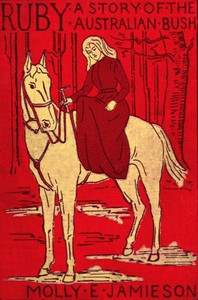
Before opening Ruby: A Story of the Australian Bush — Key Ideas to Explore, the edition data offers a quick orientation: 23,250 words, 1 hr 42 min estimated reading time, and 12 detected text sections.
The text analysis averages about 17.4 words per sentence, while the detected sections provide another way to judge how the source is divided.
Project Gutenberg metadata also associates the work with “Christian life -- Juvenile fiction,” connecting these edition facts with the source record’s subject description.
Explore this collection
These alternatives are selected using recorded categories and estimated reading time.
About 184 minutes
School Stories
42,181 recorded words. 82 minutes difference from this book's estimate.
View Gutenberg source #56195About 184 minutes
School Stories
42,111 recorded words. 82 minutes difference from this book's estimate.
View Gutenberg source #56895About 211 minutes
School Stories
48,449 recorded words. 109 minutes difference from this book's estimate.
View Gutenberg source #65271Search stored excerpts and compare books → Choose by your preferences →
Choices use stored catalog measurements. Estimates vary with reading speed. A shared category is a catalog label, not a claim that two books have the same argument or literary quality.
Search reads excerpt text stored with this catalog and links to its associated Gutenberg record. The connection is stored in the site database; this tool does not recheck that every excerpt is word-for-word identical to that external record. Excerpt search does not cover every chapter and does not verify historical publication dates.
Catalog snapshot checked: 2026-09-26. Coverage: 90 public books, 90 available source excerpts.
Calculated from edition completeness, EPUB availability, text structure and catalogue metadata. Not a user rating.
Total of 100 points, scaled to a 2.5-5.0 range. Editions with an empty description or a missing EPUB file are not scored.
Public-domain source text
The source text is kept in the dedicated reader, separate from this catalogue record and its commentary.
Ruby Thorne spends Christmas Day watching for her father, not opening presents. The opening chapter of Molly E. Jamieson's 1890s novel immediately establishes a tension between holiday expectation and the physical reality of an Australian summer: the pudding lies heavy on Ruby's mind, but the blazing sun makes cold food seem welcome. The story's emotional center is Ruby's anxious waiting, not religious observance or festive cheer.
The catalog subjects list 'Christian life' and 'Christmas stories,' yet the excerpts show religion surfacing mainly through the Scottish servant Jenny's dialect-heavy exhortations to 'pit yer trust in the Lord.' Ruby herself resists this comfort, wanting only her father. The bush setting dominates—the creek, the glare, the distant flames—making the Christian framing feel secondary to the landscape and the child's psychology.
Ruby's primary activity in the excerpts is waiting. She stands on the verandah, shading her eyes, scanning the path by the river. She leaves dinner untouched, sits with knees drawn up, and returns to her post after tea. The narrative slows to match her vigil: 'the long, long afternoon wears away,' and the reader feels the tedium through repeated descriptions of the glare and the unchanging view.
This waiting is not passive but charged with fear. Ruby watches flames 'leaping up into the still air' and imagines harm befalling her father. Her stepmother, Mrs. Thorne, lies on the sofa with 'fretful little lines about the corners of the mouth,' offering no comfort. The emotional weight falls entirely on Ruby, making her a solitary figure in a landscape that offers no distraction.
The text uses waiting to reveal character: Ruby's love for her father is absolute—'All her love is centred in dad'—and she never mentions her deceased mother. This single-minded attachment drives the plot forward, even when nothing visible happens.
Jenny, the servant, speaks in a thick Scots dialect that contrasts sharply with the standard English of the narration and other characters. She calls Ruby 'ma lambie,' asks 'Are ye no weel?' and sighs for 'bonnie Scotland' with its 'shady glens.' After six years in Australia, her tongue remains 'aggressively Scotch,' as the narrator notes.
This linguistic difference does more than add local color. Jenny's voice introduces a religious perspective that Ruby resists. When Ruby frets about her father, Jenny says 'Pit yer trust in the Lord,' but Ruby 'only wriggles again' and wants no solemn talk. The dialect marks Jenny as an outsider—both culturally and spiritually—whose comfort fails to reach the child.
The excerpts also show Jenny's practical role: she washes dishes, tidies, and makes tea. Her dialect appears in domestic contexts, grounding her piety in daily labor. The contrast between her steady routine and Ruby's anxious watching underscores the story's focus on interior experience over external action.
The Australian bush in these excerpts is not a backdrop but an active presence. The sun blazes 'in remorseless strength,' the creek dances 'on its way to the river,' and the blue distances stretch in 'long, monotonous undulation.' The heat is palpable: Christmas pudding seems irrelevant, and even the 'breath o' caller air' Jenny seeks is impossible.
Fire dominates the second excerpt. Ruby watches flames 'like so many forked and lurid tongues' from Glengarry, and the narrative links the fire to her father's absence. The landscape becomes a source of threat, not beauty. The 'hazy blue of the summer sky' is 'strangely out of place' against the flames, suggesting a world where natural beauty and danger coexist uneasily.
Distance matters too. Ruby watches 'the pathway by the river' where she rode with Dick that morning, but the return never comes within the excerpts. The bush separates people: Ruby from her father, Jenny from Scotland, the stepmother from any engagement. The setting enforces isolation, making Ruby's waiting both a personal ordeal and a condition of life in this place.
Readers approaching Ruby: A Story of the Australian Bush should set aside expectations of a conventional Christmas story or a didactic Christian tale. The excerpts suggest a narrative driven by a child's emotional intensity and a vividly rendered environment, with religious elements appearing as one voice among many. Pay attention to what Ruby does not say—about her mother, about her stepmother's past, about what happens next—as the gaps may be as telling as the text itself.
There’s something about Ruby’s fierce little heart, waiting through that scorching Christmas for her father, that stays with you. It made me think of another old favourite, The Cadets of Flemming Hall — Reading Companion, where the quiet ache of wanting to belong feels just as real. Both remember childhood as longing, not just adventure.
Create a short personal record of your experience with this book.