About 184 minutes
A Yankee Flier in the Far East — Background and Themes
School Stories
42,111 recorded words. 0 minutes difference from this book's estimate.
View Gutenberg source #56895
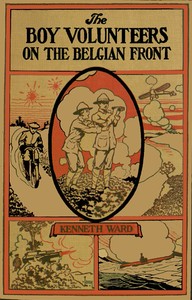
The Boy Volunteers on the Belgian Front — Reading Companion can be approached with a clearer sense of reading commitment from its source measurements: 42,181 words, 3 hr 4 min estimated reading time, and 18 detected text sections.
The text analysis averages about 15.7 words per sentence, while the detected sections provide another way to judge how the source is divided.
Project Gutenberg metadata also associates the work with “War stories,” connecting these edition facts with the source record’s subject description.
Explore this collection
These alternatives are selected using recorded categories and estimated reading time.
About 184 minutes
School Stories
42,111 recorded words. 0 minutes difference from this book's estimate.
View Gutenberg source #56895About 211 minutes
School Stories
48,449 recorded words. 27 minutes difference from this book's estimate.
View Gutenberg source #65271About 225 minutes
School Stories
51,730 recorded words. 41 minutes difference from this book's estimate.
View Gutenberg source #55964Search stored excerpts and compare books → Choose by your preferences →
Choices use stored catalog measurements. Estimates vary with reading speed. A shared category is a catalog label, not a claim that two books have the same argument or literary quality.
Search reads excerpt text stored with this catalog and links to its associated Gutenberg record. The connection is stored in the site database; this tool does not recheck that every excerpt is word-for-word identical to that external record. Excerpt search does not cover every chapter and does not verify historical publication dates.
Catalog snapshot checked: 2026-09-26. Coverage: 90 public books, 90 available source excerpts.
Calculated from edition completeness, EPUB availability, text structure and catalogue metadata. Not a user rating.
Total of 100 points, scaled to a 2.5-5.0 range. Editions with an empty description or a missing EPUB file are not scored.
Public-domain source text
The source text is kept in the dedicated reader, separate from this catalogue record and its commentary.
Kenneth Ward's The Boy Volunteers on the Belgian Front (1917) opens with an interrupted train journey, immediately establishing a pattern of abrupt, event-driven plotting. The author's diction leans toward the expository: characters often state what they see or have just learned, as when Ralph identifies the train-stoppers with a simple declarative sentence. This directness, paired with frequent shifts between action and historical digression, shapes the book's particular rhythm.
Ward uses dialogue primarily to convey facts rather than to develop character. When Ralph says, “They are the fellows who stopped our train,” the line serves to label the antagonists for the reader. Later, Alfred’s remark about being wounded—“it’s something to get in the way of a bullet that has been shot by an enemy for the purpose of killing”—reads less as natural speech and more as a moral summary. The surrounding men’s reaction (“turned their heads away”) suggests the author intends this as a moment of reflection, yet the phrasing remains instructional. Throughout the excerpts, exchanges between the boys rarely diverge from the immediate situation; they report, explain, or react in ways that keep the plot moving forward without much interiority.
In Chapter X, Ward pauses the narrative to describe Belgium’s limestone quarries, an old Roman road, and battles from 1693 and 1793. The passage asserts that “it is no wonder that their proximity to the great battlefields should make the Belgians good soldiers,” linking geography to national character. This digression is typical of the book’s method: the author inserts mini-lectures on local history, often tied to the setting. The commander, “a descendant of a famous family,” serves as a conduit for this information. These asides break from the boys’ immediate experiences, offering a wider historical frame that the young protagonists themselves do not comment on. The effect is a layered text where adventure and textbook-like exposition coexist.
Ward pays careful attention to the physical consequences of war. Ralph is weakened by loss of blood and carried on a caisson, while Alfred is “too fatigued to care where he slept.” The author specifies that Ralph could only sleep “after he became accustomed to the rolling motion of the heavy ordnance wagon,” a concrete detail that grounds the adventure in bodily experience. The contrast between the two boys—one injured, one exhausted—creates a quiet differentiation in their roles. Alfred’s regretful tone about not being wounded, and Ralph’s brightening face, hint at a hierarchy of valor tied to physical sacrifice. These details, though sparing, give the narrative a tactile quality that the more abstract historical passages lack.
The account of the night march toward Tongres is rendered with procedural clarity: the corporal makes rounds, picket patrols are gathered, the retreat is “effected without the knowledge of the Germans.” Ward specifies times (“promptly at twelve,” “at two in the morning”) and movements (the force halts, rests, moves on). Alfred finds the night operations “fascinating,” but the description itself remains functional, emphasizing order and silence. The author’s choice to detail the handling of guns and the composition of the rear guard reflects an interest in military mechanics. For a young reader, these passages offer a step-by-step view of troop movement, turning the chaos of war into a series of manageable, almost procedural steps.
Readers attentive to authorial craft will notice how Ward balances boyish dialogue, historical asides, and tactical detail. The book does not aim for psychological depth; instead, it builds a world where information—whether about a Roman road or the proper way to move artillery—is part of the adventure. The excerpts suggest a work that instructs as much as it entertains, embedding lessons about history, geography, and military procedure within a straightforward narrative of two American boys at war.
I remember sitting with my grandfather’s old war stories, feeling the weight of those boy adventurers’ choices. This companion’s careful notes on dialogue reminded me of how another book, The Boy Traders; Or, The Sportsman's Club Among the Boers — Themes and Context, once gave me that same quiet ache—boys learning duty not from speeches, but from the dirt and silence between words. Both linger like afternoon shadows.
A brief reflection can help important ideas stay with you longer.