About 211 minutes
Gloria at Boarding School — Story, Setting & Ideas
School Stories
48,449 recorded words. 14 minutes difference from this book's estimate.
View Gutenberg source #65271
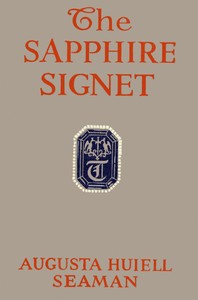
The Sapphire Signet — Background and Themes can be approached with a clearer sense of reading commitment from its source measurements: 51,730 words, 3 hr 45 min estimated reading time, and 23 detected text sections.
The text analysis averages about 14.9 words per sentence, while the detected sections provide another way to judge how the source is divided.
Project Gutenberg metadata also associates the work with “Girls -- Juvenile fiction,” connecting these edition facts with the source record’s subject description.
Explore this collection
These alternatives are selected using recorded categories and estimated reading time.
About 211 minutes
School Stories
48,449 recorded words. 14 minutes difference from this book's estimate.
View Gutenberg source #65271About 241 minutes
School Stories
55,384 recorded words. 16 minutes difference from this book's estimate.
View Gutenberg source #62063About 255 minutes
School Stories
58,615 recorded words. 30 minutes difference from this book's estimate.
View Gutenberg source #58073Search stored excerpts and compare books → Choose by your preferences →
Choices use stored catalog measurements. Estimates vary with reading speed. A shared category is a catalog label, not a claim that two books have the same argument or literary quality.
Search reads excerpt text stored with this catalog and links to its associated Gutenberg record. The connection is stored in the site database; this tool does not recheck that every excerpt is word-for-word identical to that external record. Excerpt search does not cover every chapter and does not verify historical publication dates.
Catalog snapshot checked: 2026-09-26. Coverage: 90 public books, 90 available source excerpts.
Calculated from edition completeness, EPUB availability, text structure and catalogue metadata. Not a user rating.
Total of 100 points, scaled to a 2.5-5.0 range. Editions with an empty description or a missing EPUB file are not scored.
Public-domain source text
The source text is kept in the dedicated reader, separate from this catalogue record and its commentary.
The story opens not with a crime but with a vigil: a girl in an invalid-chair watches from behind parted curtains, waiting for two friends to arrive on a dark Charlton Street afternoon. The narrative voice shifts between the girls' present-tense excitement and the formal, eighteenth-century diary entries they uncover. Seaman uses this dual timeline to control pace—the modern scenes move in quick, colloquial dialogue, while the diary slows to a measured, anxious rhythm. The diary's author, Alison Trenham, writes in a style that mimics period speech: 'I do grievously repent my folly' and 'Phœbe and I did raid the steward's secret hiding-place.' This contrast in voice is the engine of the mystery, as the girls must bridge two centuries of language and custom.
The excerpts show Seaman layering two distinct narrative voices. The framing story uses brisk, modern dialogue: 'Bully! Hot stuff!' exclaims Alexander, while Corinne interrupts with 'Isn't this exciting!' These interjections break up the dense historical passages, preventing the diary from overwhelming the reader. The diary itself, however, employs a formal, slightly archaic vocabulary—'consummated,' 'guileless ignorance,' 'vile conspirators'—and a measured syntax that suggests a young woman writing under duress. The shift is abrupt: one paragraph ends with a girl's casual remark, the next begins with 'It is midnight, and on the morrow the plot will be consummated.' This alternation creates a rhythmic tension, as the modern voice pulls us back to the present just as the historical crisis peaks.
Seaman controls the story's pace by parceling out the diary in fragments. The girls read aloud, stopping to comment or exclaim, which mimics the experience of solving a puzzle piece by piece. The diary itself contains gaps—'another space' or 'another entry'—that mirror the incomplete nature of the evidence. The pace quickens when the diary reveals a deadline: 'the plot is near completion; that if all goes well, 'twill be put in action four days from now.' This countdown injects urgency into both the historical and modern timelines. Yet the modern scenes slow down for deliberation: 'Well, that settles one question, anyhow!' Corinne interrupts, and the group discusses what they've learned. These pauses allow the reader to catch up, then the diary resumes its forward drive.
Recurring physical details anchor the mystery. The trunk with a false bottom is the central object—Corinne notices 'the bottom of the trunk seemed all wrong,' a clue that leads to the diary. The signet ring of the title appears only in the illustrations' captions, but the diary itself becomes a kind of object: it is hidden, discovered, and read aloud. Seaman also uses setting to control mood. The opening paragraph dwells on darkness: 'a very dull, dark afternoon,' 'lights had twinkled out,' 'the dim street.' This atmospheric pressure contrasts with the bright, eager voices of the girls. The historical setting—a house in Greenwich Village during the Revolution—is evoked through small details: 'the steward's secret hiding-place in the wine-cellar,' 'Madame M.'s health does not improve.' These objects and places are not described at length; they are mentioned in passing, leaving the reader to fill in the shadows.
Readers should pay attention to how Seaman uses the girls' reactions to shape the diary's impact. The interruptions are not distractions; they are interpretive cues. Notice also how the diary's language grows more urgent as the plot deadline approaches—the shift from 'I have confided my story' to 'It is midnight, and on the morrow' is a deliberate acceleration. The incomplete excerpts leave the resolution uncertain, but the pattern of voice and pace offers a reliable guide to the story's structure.
The old diary in The Sapphire Signet, hidden away in its false bottom, made me think of letters my grandfather kept from wartime—not the Revolution, but another age. That same hushed feeling of finding something meant to stay secret. It lingered, so I returned to The Boy Volunteers on the Belgian Front — Reading Companion, where a similar quiet urgency waits between the lines.
Create a short personal record of your experience with this book.