About 298 minutes
The Cadets of Flemming Hall — Reading Companion
School Stories
68,463 recorded words. 1 minutes difference from this book's estimate.
View Gutenberg source #59005
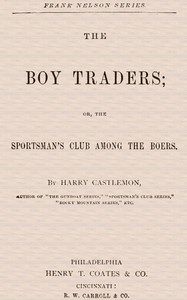
Before opening The Boy Traders; Or, The Sportsman's Club Among the Boers — Themes and Context, the edition data offers a quick orientation: 68,111 words, 4 hr 57 min estimated reading time, and 19 detected text sections.
The text analysis averages about 20.3 words per sentence, while the detected sections provide another way to judge how the source is divided.
Project Gutenberg metadata also associates the work with “Voyages and travels -- Juvenile fiction,” connecting these edition facts with the source record’s subject description.
Explore this collection
These alternatives are selected using recorded categories and estimated reading time.
About 298 minutes
School Stories
68,463 recorded words. 1 minutes difference from this book's estimate.
View Gutenberg source #59005About 314 minutes
School Stories
72,173 recorded words. 17 minutes difference from this book's estimate.
View Gutenberg source #56752About 255 minutes
School Stories
58,615 recorded words. 42 minutes difference from this book's estimate.
View Gutenberg source #58073Search stored excerpts and compare books → Choose by your preferences →
Choices use stored catalog measurements. Estimates vary with reading speed. A shared category is a catalog label, not a claim that two books have the same argument or literary quality.
Search reads excerpt text stored with this catalog and links to its associated Gutenberg record. The connection is stored in the site database; this tool does not recheck that every excerpt is word-for-word identical to that external record. Excerpt search does not cover every chapter and does not verify historical publication dates.
Catalog snapshot checked: 2026-09-26. Coverage: 90 public books, 90 available source excerpts.
Calculated from edition completeness, EPUB availability, text structure and catalogue metadata. Not a user rating.
Total of 100 points, scaled to a 2.5-5.0 range. Editions with an empty description or a missing EPUB file are not scored.
Public-domain source text
The source text is kept in the dedicated reader, separate from this catalogue record and its commentary.
The excerpts from Harry Castlemon's The Boy Traders; Or, The Sportsman's Club Among the Boers open with a tense scene aboard the schooner Stranger, where Captain Uncle Dick warns his nephew Frank of an approaching cyclone. Frank, serving as sailing-master, marks the vessel's position on a chart and discusses the cyclone's rotary motion. The dialogue is brisk and technical, emphasizing seamanship over characterization. Notably, the catalog subjects list 'Afrikaners' and 'Boers,' yet the provided text contains no mention of either group. Instead, the action centers on nautical hazards and a later mutiny plot, suggesting the Boer content may appear in later chapters not included here.
The opening dialogue between Frank and Uncle Dick establishes a pattern of technical exchange. Frank notes the barometer falling and recalls the schooner's recent pounding, while Uncle Dick responds with confidence: 'Give me a tight craft, a good crew, and plenty of elbow-room.' The conversation is laced with navigational specifics—Frank points out the schooner's position on a chart, marks it with a red pencil, and identifies their location south of the equator. This precision suggests Castlemon aimed for verisimilitude in maritime details, likely drawing on his own experience or research. The dialogue also reveals character through understatement: Frank's anxiety about coral reefs is met with Uncle Dick's pragmatic 'it is our business to keep clear.' Such exchanges prioritize action over introspection, fitting the adventure genre.
In a later excerpt, the mutiny subplot introduces a different kind of tension. Archie, previously dismissed as a 'little boy,' secretly irons the giant Waters while he sleeps, then wakes Frank with a revolver. The scene is described with physical detail: Archie's face 'white as a sheet,' perspiration 'in great beads,' and the 'cold irons' that might have roused the giant. Archie's whispered boast—'We'll have the schooner in five minutes more'—contrasts with his earlier self-deprecating humor about not being born during the American Revolution. The mutiny is resolved offstage, but the episode showcases Archie's resourcefulness and shifts the power dynamic between the cousins. The text implies a theme of underestimated youth, though the excerpts do not reveal the mutineers' motives or the ultimate outcome.
Throughout the excerpts, a thread of Anglo-American rivalry surfaces in dialogue. After evading a man-of-war, the Englishman Waters praises Frank: 'It takes Yankees to do things, after all.' Archie retorts with a jab about the American Revolution, then deflates the boast with a punchline: 'I wasn't born.' This exchange, met with laughter from all except the angry Fowler, blends patriotism with self-deprecating humor. The rivalry is playful rather than hostile, and it serves to reinforce the protagonists' identity as clever Yankees. However, the catalog subject 'Afrikaners' remains absent from these interactions; the Boers are not mentioned in any of the provided text. Readers expecting Boer encounters will need to look beyond these early chapters, which focus instead on nautical adventure and interpersonal conflict aboard ship.
Readers approaching The Boy Traders should note that the catalog subjects may not align with the opening chapters. The excerpts emphasize seamanship, mutiny, and national pride rather than African settings or Boer interactions. Pay attention to how Castlemon builds suspense through technical dialogue and physical detail, and consider how the title's promise of 'Among the Boers' might be fulfilled later in the narrative. The text rewards attention to nautical terminology and character dynamics.
Reading about Frank and Archie outrunning a cyclone brought back afternoons sprawled on my grandfather’s porch, sunburned and lost in sea stories. That same swell of adventure returned when I first opened A Yankee Flier in the Far East — Background and Themes, another world where pluck and rivalry blur into distance. Some books simply feel like old friends whispering from a shelf.
Capture what you thought, learned, and would like to remember.