About 118 minutes
Don, a Runaway Dog: His Many Adventures — Themes and Context
Young Readers
27,010 recorded words. 2 minutes difference from this book's estimate.
View Gutenberg source #61401
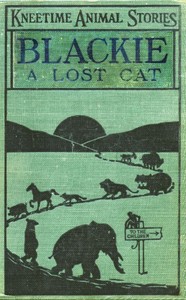
The source record for Blackie, a Lost Cat: Her Many Adventures — Edition Insights measures this digital text at 27,384 words, 2 hr estimated reading time, and 13 detected text sections.
The text analysis averages about 13.4 words per sentence, while the detected sections provide another way to judge how the source is divided.
Project Gutenberg metadata also associates the work with “Animals -- Juvenile fiction,” connecting these edition facts with the source record’s subject description.
Explore this collection
These alternatives are selected using recorded categories and estimated reading time.
About 118 minutes
Young Readers
27,010 recorded words. 2 minutes difference from this book's estimate.
View Gutenberg source #61401About 107 minutes
Young Readers
24,514 recorded words. 13 minutes difference from this book's estimate.
View Gutenberg source #60065About 138 minutes
Young Readers
31,518 recorded words. 18 minutes difference from this book's estimate.
View Gutenberg source #53269Search stored excerpts and compare books → Choose by your preferences →
Choices use stored catalog measurements. Estimates vary with reading speed. A shared category is a catalog label, not a claim that two books have the same argument or literary quality.
Search reads excerpt text stored with this catalog and links to its associated Gutenberg record. The connection is stored in the site database; this tool does not recheck that every excerpt is word-for-word identical to that external record. Excerpt search does not cover every chapter and does not verify historical publication dates.
Catalog snapshot checked: 2026-09-26. Coverage: 90 public books, 90 available source excerpts.
Calculated from edition completeness, EPUB availability, text structure and catalogue metadata. Not a user rating.
Total of 100 points, scaled to a 2.5-5.0 range. Editions with an empty description or a missing EPUB file are not scored.
Public-domain source text
The source text is kept in the dedicated reader, separate from this catalogue record and its commentary.
From the opening sentence—'Blackie was a cat'—Richard Barnum establishes a direct, matter-of-fact voice that treats his feline protagonist with the same seriousness a human character might receive. The narrative quickly introduces a pattern of escape and pursuit: Blackie springs 'under a wagon, between the legs of a horse and under an automobile' while a red-haired boy chases her. This moment, depicted in the frontispiece, encapsulates the book's central dynamic—a lost animal navigating a world of sudden threats and unfamiliar spaces.
The book's thirteen chapters follow a clear episodic pattern. Each chapter title—'Blackie Hears Something,' 'Blackie Runs Away,' 'Blackie in Trouble'—functions as a mini-summary of the action to come. The narrative moves from one predicament to the next, often triggered by a sound or a sudden event. For instance, Blackie's flight from the railroad station begins when an engine whistle startles her, and she hides 'in among the boxes and barrels.' The rhythm is consistent: Blackie encounters a danger, escapes, finds temporary safety, and then a new threat emerges. This structure, common in early twentieth-century animal adventure series, keeps the plot moving briskly while allowing each chapter to stand as a self-contained incident.
Barnum builds the story's world through specific sensory cues. Blackie navigates by smell and sound: she 'sniffed the air hard, and she smelled water' to find a drinking fountain, and she listens for danger, noting when 'it grew more quiet about the railroad station.' The narrative often describes what Blackie hears—'men and boys walked up and down the platform, whistling and calling'—before she acts. These details ground the cat's perspective in a tangible environment. The loss of her 'red ribbon, with the tinkling bell' when it catches on the fountain is a small but telling moment: the bell, a marker of domestic ownership, is stripped away as she enters the wilder world of the country town.
The story traces Blackie's journey from a 'fine large house' shared with children Arthur and Mabel to increasingly alien settings: a railroad station, a country town, and later encounters with other animals. The transition is marked by a shift in scale. In the house, Blackie is fed and cared for; at the station, she becomes a lost object, pursued for a dollar reward. Barnum emphasizes the contrast through Blackie's own thoughts: 'I'll go back to her after dark,' she decides, still expecting to return to a known home. But the narrative never allows her to retrace her steps. Each chapter pushes her further into unfamiliar territory, and the reader follows her through a landscape that grows more crowded with strangers—boys, dogs, and even a bear—as the domestic safety recedes.
Human figures in the story function primarily as agents of change rather than fully developed personalities. The red-haired boy who chases Blackie for a dollar is a type—the opportunistic child—rather than an individual. Mrs. Thompson, who loses Blackie at the station, disappears from the narrative after offering a reward. Even Arthur and Mabel, introduced as loving owners, are left behind after the first chapter. This flattening of human characters keeps the focus squarely on Blackie's experience. The humans are obstacles or helpers, but their motives are simple and their appearances brief. The result is a story in which the animal's perspective dominates, and the world is seen through her cautious, sensory-driven point of view.
Readers approaching Blackie, a Lost Cat should attend to the way Barnum uses repetition and variation. Each escape follows a similar arc, but the settings and antagonists shift, creating a sense of progression without a traditional plot arc. The book rewards attention to small details—the bell lost, the water tasted, the shadows where Blackie hides—that accumulate into a portrait of a creature learning to survive on her own terms.
There’s something tender about watching Blackie drift between the familiar hearth and the unknown dark, each stop a small test of nerve. It reminded me, oddly, of those old Larry Dexter tales, where a boy’s errand turns strange just past the town line. Larry Dexter and the Stolen Boy; or, A Young Reporter on the Lakes — Reading Notes holds that same quiet ache of being far from home, retracing steps by memory alone. I still think about Blackie’s paws on the cold pavement.
Use these questions to collect your thoughts before moving on.

![Cover of Atom Mystery [Young Atom Detective] — Reading Companion](https://axepu.com/storage/media/covers/pg53269.jpg)