About 107 minutes
Wings and Stings: A Tale for the Young — Text and Context
Young Readers
24,514 recorded words. 51 minutes difference from this book's estimate.
View Gutenberg source #60065
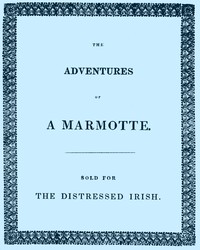
The catalog record for The Adventures of a Marmotte Sold for the Distressed Irish — Background and Themes provides practical reading context through 12,846 words, 56 min estimated reading time, and 5 detected text sections.
The text analysis averages about 33.7 words per sentence, while the detected sections provide another way to judge how the source is divided.
Project Gutenberg metadata also associates the work with “Children and animals -- Juvenile fiction,” connecting these edition facts with the source record’s subject description.
Explore this collection
These alternatives are selected using recorded categories and estimated reading time.
About 107 minutes
Young Readers
24,514 recorded words. 51 minutes difference from this book's estimate.
View Gutenberg source #60065About 118 minutes
Young Readers
27,010 recorded words. 62 minutes difference from this book's estimate.
View Gutenberg source #61401About 120 minutes
Young Readers
27,384 recorded words. 64 minutes difference from this book's estimate.
View Gutenberg source #61654Search stored excerpts and compare books → Choose by your preferences →
Choices use stored catalog measurements. Estimates vary with reading speed. A shared category is a catalog label, not a claim that two books have the same argument or literary quality.
Search reads excerpt text stored with this catalog and links to its associated Gutenberg record. The connection is stored in the site database; this tool does not recheck that every excerpt is word-for-word identical to that external record. Excerpt search does not cover every chapter and does not verify historical publication dates.
Catalog snapshot checked: 2026-09-26. Coverage: 90 public books, 90 available source excerpts.
Calculated from edition completeness, EPUB availability, text structure and catalogue metadata. Not a user rating.
Total of 100 points, scaled to a 2.5-5.0 range. Editions with an empty description or a missing EPUB file are not scored.
Public-domain source text
The source text is kept in the dedicated reader, separate from this catalogue record and its commentary.
Eliza Grey's The Adventures of a Marmotte (1831) opens with a striking authorial choice: the narrator is the marmot itself, addressing readers directly as 'my dear little friends.' This first-person animal perspective was unusual for the period and immediately establishes a bond between the creature and its audience. The preface reveals the book's charitable purpose—'procuring a few shillings for the poor starving Irish'—which frames the entire narrative as both entertainment and moral appeal. Grey's diction in the opening paragraphs is notably conversational, with the marmot confessing 'great boldness' in writing its own history, a self-deprecating tone that invites sympathy.
The marmot's narration blends childlike wonder with adult moralizing. When captured, it describes 'my horror—my despair' and immediately draws a lesson: 'naughtiness is always punished sooner or later.' This dual voice—experiencing and reflecting—characterizes Grey's style. The animal uses exclamations ('Oh! fatal effect of disobedience!') and direct addresses to readers ('I hope my little readers never do any thing they are bid not'), creating an intimate, instructional tone. The diction is simple but vivid: the marmot recalls being 'curled up like a little ball' in an Alpine crevice, and later marvels at the sea as 'an enormous quantity of water all collected together.' These phrases reveal a creature learning to name the world, a technique that keeps the perspective consistently animal while allowing moral commentary.
Grey grounds the narrative in specific geography. The marmot's birthplace is 'near the pretty village of Courmayeur, situated in the valley of Aosta, in Switzerland,' and the valley 'extends from the pass of St. Martin ... to St. Bernard.' Such precise location names are rare in children's literature of the era and suggest Grey's familiarity with the region or careful research. Later, the journey to England includes a crossing from Calais on a 'Steam Boat,' and the marmot notes the 'enormous quantity of water' at Boulogne. These details anchor the fantasy in real places, contrasting the wild Alps with cultivated English estates. The farm description—'nice clean kitchen, with its sanded floor, bright oven, great arm chair, and large wooden clock'—shows Grey's eye for domestic interiors, offering a child reader concrete images of a new world.
Grey populates the journey with memorable minor characters, described through the marmot's naive observations. On the steamboat, Miss Wilnemina Pugabunder appears with a menagerie: a 'little French Poodle, with a silver collar, ornamented with small bells,' an 'Angola Cat' named Silver Tabby, a macaw, guinea-pigs, and goldfish. The marmot notes the chaos—'the dog did not like the parrot, and the cat seemed to have rather too great an affection for the fish'—and the mistress's frantic efforts to keep peace. Another passenger, an 'old lady' of 'enormous size,' travels with a dwarf husband whom the marmot initially mistakes for her son. These vignettes serve no plot function but enrich the texture of the world, showing Grey's interest in eccentricity and social observation. The marmot's judgments are gentle: it finds the lady's affection for pets 'ridiculous' but does not condemn.
The story follows a clear arc from disobedience (leaving the nest) to capture, travel, and eventual integration into a kind English family. The marmot's initial transgression—'contrary to the express commands of my parents'—triggers all subsequent events, and Grey repeatedly returns to the lesson that 'naughtiness is always punished.' Yet the moralizing is tempered by the marmot's genuine affection for its captors: the boy who caught it 'treated me very kindly,' and later the Young Lord and his sister Lucy are portrayed as benevolent. Lucy's charity—'spent all her money in buying them clothes, which she made herself'—models the behavior Grey hopes to inspire in readers. The narrative thus serves a dual purpose: entertaining with animal adventures while promoting obedience and generosity, especially toward the 'poor starving Irish' mentioned in the preface. The structure is episodic, moving from Switzerland to Paris to England, each location offering new sights and lessons.
Readers should attend to how Grey balances the marmot's animal nature with its human-like moral consciousness. The narrator remains recognizably a marmot—frightened of humans, fond of jumping, curious about new foods—yet speaks with a Victorian child's vocabulary and concerns. This hybrid voice is the book's chief literary interest. The charitable frame, unusual for a children's animal story, gives the adventures a specific historical context: the Irish famine of the 1820s-30s. Grey's preface asks for 'allowances for the faults it may contain,' a modest plea that invites readers to engage critically with this small, purposeful work.
Eliza Grey's marmot speaks of exile with a gentle, worried paw, and I often think of that plaintive voice when recalling another stray. Blackie, a Lost Cat: Her Many Adventures — Edition Insights shares that quiet scramble for home and kindness, a small creature’s heart laid bare on the page. Both are dear companions on lonely shelves.
Capture what you thought, learned, and would like to remember.
![Cover of Atom Mystery [Young Atom Detective] — Reading Companion](https://axepu.com/storage/media/covers/pg53269.jpg)