About 120 minutes
Blackie, a Lost Cat: Her Many Adventures — Edition Insights
Young Readers
27,384 recorded words. 2 minutes difference from this book's estimate.
View Gutenberg source #61654
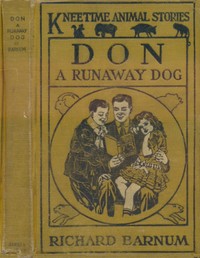
This digital edition of Don, a Runaway Dog: His Many Adventures — Themes and Context is described by source-level measurements including 27,010 words, 1 hr 58 min estimated reading time, and 13 detected text sections.
The text analysis averages about 13.5 words per sentence, while the detected sections provide another way to judge how the source is divided.
Project Gutenberg metadata also associates the work with “Dogs -- Juvenile fiction,” connecting these edition facts with the source record’s subject description.
Explore this collection
These alternatives are selected using recorded categories and estimated reading time.
About 120 minutes
Young Readers
27,384 recorded words. 2 minutes difference from this book's estimate.
View Gutenberg source #61654About 107 minutes
Young Readers
24,514 recorded words. 11 minutes difference from this book's estimate.
View Gutenberg source #60065About 138 minutes
Young Readers
31,518 recorded words. 20 minutes difference from this book's estimate.
View Gutenberg source #53269Search stored excerpts and compare books → Choose by your preferences →
Choices use stored catalog measurements. Estimates vary with reading speed. A shared category is a catalog label, not a claim that two books have the same argument or literary quality.
Search reads excerpt text stored with this catalog and links to its associated Gutenberg record. The connection is stored in the site database; this tool does not recheck that every excerpt is word-for-word identical to that external record. Excerpt search does not cover every chapter and does not verify historical publication dates.
Catalog snapshot checked: 2026-09-26. Coverage: 90 public books, 90 available source excerpts.
Calculated from edition completeness, EPUB availability, text structure and catalogue metadata. Not a user rating.
Total of 100 points, scaled to a 2.5-5.0 range. Editions with an empty description or a missing EPUB file are not scored.
Public-domain source text
The source text is kept in the dedicated reader, separate from this catalogue record and its commentary.
From the opening paragraph, Richard Barnum establishes Don's world through sensory details rooted in a puppy's limited experience. The narrator notes that Don's eyes "were made to stay closed until he grew to be a little stronger," a choice that aligns the reader with the protagonist's physical vulnerability. The mother dog, Mrs. Gurr, speaks in a matter-of-fact tone—"I can tell you everything that happens"—blending animal communication with human-like reassurance. This early passage sets up a pattern: the story filters events through Don's senses (smell, thirst, hunger) while the narrator occasionally steps back to address the child reader directly, as in "I very much doubt if dogs use mirrors,—don't you?"
Barnum consistently describes the world as Don perceives it through smell, sound, and physical sensation. When Don escapes a freight car, he "tried to smell his way to the nearest water" and later "smelled meat" that draws him toward danger. The narrative rarely attributes human reasoning to Don; instead, it presents his motivations as instinctive: thirst, hunger, fear. Even the regret "if ever I get safely back to my kennel once more, I'll never run away again" is framed as a thought that occurs to him after the fact, not as a moral lesson. This sensory grounding keeps the story anchored in a dog's reality, even as the narrator anthropomorphizes Don's internal monologue.
The narrator frequently breaks the fourth wall to speak directly to the child reader. Comments like "I suppose they were made to stay closed" and "I very much doubt if dogs use mirrors" create a conversational, explanatory tone. This technique serves two purposes: it clarifies biological or behavioral facts (puppies' eyes stay shut for protection) and it builds a friendly, guiding presence. The narrator also uses inclusive language—"you know, doggies have a language of their own"—to invite the reader into a shared understanding of animal communication. These asides are consistent throughout the excerpts, making the narrator a character in the reading experience.
The chapter titles and the excerpted content reveal a tightly episodic structure. Each chapter presents a discrete encounter—falling into water, meeting other animals, riding in a freight car—that advances Don's journey without requiring cumulative plot knowledge. Within chapters, Barnum uses short paragraphs and frequent action verbs ("jumped," "ran," "trotted") to maintain momentum. The pacing mirrors a child's attention span: a problem arises (thirst, hunger, confinement), Don acts, and a resolution or new complication appears quickly. This structure allows the book to function as a series of standalone adventures while building toward a reunion hinted at in the final illustration caption.
Harriet H. Tooker's illustrations, described in captions, often preview key moments or emotional beats. The frontispiece shows Don "marching around like a soldier dog, with the broom for a gun," an image that establishes his playful, trainable nature before the story begins. Later captions—"He was all tangled up in the meshes of the net" and "It's my dog, Don, that ran away from the farm"—signal turning points. These visual summaries work in tandem with the text, giving young readers a concrete reference for the action. The captions also use direct speech, echoing the dialogue style of the prose and reinforcing the book's emphasis on spoken interaction between animals and humans.
Readers may notice how Barnum balances animal instinct with human-like dialogue, a choice that makes Don relatable without losing his doggishness. The episodic chapters invite reading aloud, with each segment offering a natural stopping point. Pay attention to the way the narrator's voice shifts between explaining and storytelling—this dual role is a key feature of early twentieth-century children's animal fiction.
Reading how Don experiences the world through scents and sounds, I found myself drifting back to another old favorite, Larry Dexter and the Stolen Boy; or, A Young Reporter on the Lakes — Reading Notes. Both feel like quiet companions from another era, their adventures unfolding at a gentler pace, where each small detail—a particular smell, a fleeting glance—carries its own weight of meaning.
Create a short personal record of your experience with this book.

![Cover of Atom Mystery [Young Atom Detective] — Reading Companion](https://axepu.com/storage/media/covers/pg53269.jpg)