About 118 minutes
Don, a Runaway Dog: His Many Adventures — Themes and Context
Young Readers
27,010 recorded words. 11 minutes difference from this book's estimate.
View Gutenberg source #61401
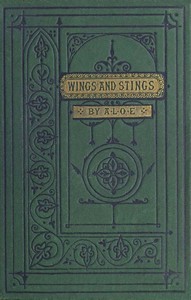
The catalog record for Wings and Stings: A Tale for the Young — Text and Context provides practical reading context through 24,514 words, 1 hr 47 min estimated reading time, and 16 detected text sections.
The text analysis averages about 19.5 words per sentence, while the detected sections provide another way to judge how the source is divided.
Project Gutenberg metadata also associates the work with “Christian life -- Juvenile fiction,” connecting these edition facts with the source record’s subject description.
Explore this collection
These alternatives are selected using recorded categories and estimated reading time.
About 118 minutes
Young Readers
27,010 recorded words. 11 minutes difference from this book's estimate.
View Gutenberg source #61401About 120 minutes
Young Readers
27,384 recorded words. 13 minutes difference from this book's estimate.
View Gutenberg source #61654About 138 minutes
Young Readers
31,518 recorded words. 31 minutes difference from this book's estimate.
View Gutenberg source #53269Search stored excerpts and compare books → Choose by your preferences →
Choices use stored catalog measurements. Estimates vary with reading speed. A shared category is a catalog label, not a claim that two books have the same argument or literary quality.
Search reads excerpt text stored with this catalog and links to its associated Gutenberg record. The connection is stored in the site database; this tool does not recheck that every excerpt is word-for-word identical to that external record. Excerpt search does not cover every chapter and does not verify historical publication dates.
Catalog snapshot checked: 2026-09-26. Coverage: 90 public books, 90 available source excerpts.
Calculated from edition completeness, EPUB availability, text structure and catalogue metadata. Not a user rating.
Total of 100 points, scaled to a 2.5-5.0 range. Editions with an empty description or a missing EPUB file are not scored.
Public-domain source text
The source text is kept in the dedicated reader, separate from this catalogue record and its commentary.
The author’s preface likens the book to a stile in a haymaking field—something to be scrambled over quickly—and promises that “in haymaking there is profit as well as amusement.” This metaphor sets the tone for a story that treats moral instruction as something to be gathered, not lectured. The opening chapter immediately establishes a schoolroom as a hive, with scholars as bees and knowledge as honey drawn from “the leaves of certain dog” (the text breaks off). The two sisters, Minnie and Polly, are introduced through their contrasting attitudes toward work: Minnie works steadily, while Polly wishes there were no such thing as work and watches real bees from the window. The narrative voice frequently interjects with direct commentary, such as “would that we were as eager and persevering in the pursuit of what really is precious,” signaling that the story’s moral lessons are woven into the action rather than reserved for chapter endings.
The schoolroom is described as a hive, the scholars as a swarm, and knowledge as honey. This extended metaphor is not merely decorative; it structures the moral logic of the story. Minnie’s soft voice is “scarcely heard amidst the confusion of sounds,” while Polly’s idleness is contrasted with the bees’ industry. The epigraph from Isaac Watts—“How doth the little busy bee / Improve each shining hour”—is quoted on the title page, and the narrative repeatedly returns to the idea that work makes play more enjoyable. Polly’s later pursuit of a pedlar’s trinket is framed as a failure to “improve” her time, and the bees’ constant activity serves as a foil to her neglect of duty. The metaphor also extends to the hive as a community: the school is a collective where each scholar’s diligence or laziness affects the whole.
Polly’s encounter with the pedlar is the most detailed scene in the excerpts. She covets a “brooch of false diamonds,” and the narrative emphasizes the physical cost of her pursuit: she is “heated, and tired,” her shoes “down at heel,” her hair “hung about her ears.” The pedlar’s pack is opened to reveal a cherry-coloured neckerchief, a pink silk lace, a large steel pin, and a jewelled ring—each item described with the same specificity as the bees’ honey-gathering. Polly spends all her sixpence on the brooch, only to return home to find that her neglected charge, a baby, has had a fit. The mother’s words—“I left Polly in charge of the children: I came back to find her gone”—directly link the purchase to the crisis. The narrator’s interjection, “to possess is not always to enjoy,” undercuts the satisfaction of acquisition.
A. L. O. E. (a pseudonym for Charlotte Maria Tucker) frequently breaks the narrative to address the reader. In the preface, she anticipates that young readers will skip it “as they would a stile,” and she is “not being offended if some of my friends should skip over it at one bound.” In the pedlar scene, she writes “would that we were as eager and persevering in the pursuit of what really is precious, as the girl was in that of a worthless toy!” This technique turns the story into a sermon-like exemplum, where the reader is expected to recognize the moral without it being disguised. The chapters are titled with direct phrases like “A Stinging Reproof” and “A Wonderful Bore,” which signal the didactic intent. The author’s voice is consistent: she treats the reader as a friend who needs gentle correction, not as a passive listener.
Readers will notice that the story’s moral weight falls not on grand adventures but on small, everyday choices: whether to finish a task, whether to watch bees or work, whether to spend pennies on a brooch or save them. The beehive metaphor is sustained throughout, but the most vivid passages are those that show, rather than tell, the consequences of vanity. Pay attention to how the author uses physical details—a swelled nose, a heated face, a baby’s fit—to make the abstract lesson tangible. The book rewards a slow reading that catches these concrete moments.
That rainy afternoon, I kept returning to Polly’s careless sparkle beside the hive’s quiet industry, wondering how much Vanity costs in small, domestic coin. Later, while drying the book’s edges, my hand drifted to Blackie, a Lost Cat: Her Many Adventures — Edition Insights, and found the same gentle ache—a creature wandering from warmth, learning what home means only by leaving it. Both felt like damp windowpanes; you see yourself faintly, and whatever’s past.
Save your reaction, strongest insight, and memorable passage.
![Cover of Atom Mystery [Young Atom Detective] — Reading Companion](https://axepu.com/storage/media/covers/pg53269.jpg)