1

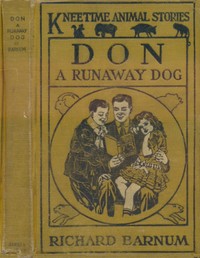
Don, a Runaway Dog: His Many Adventures — Themes and Context
(9 User reviews)
1718
Project Gutenberg
2020
Not confirmed
Dogs -- Juvenile fiction; Animals -- Juvenile fiction; Children and animals -- Juvenile fiction; Pet loss -- Juvenile fiction
Readers of public-domain and historical texts
Project Gutenberg digital edition
en
Edition facts
Words
27,010
Reading time
118 min
Text sections
13
This digital edition of Don, a Runaway Dog: His Many Adventures — Themes and Context is described by source-level measurements including 27,010 words, 1 hr 58 min estimated reading time, and 13 detected text sections.
The text analysis averages about 13.5 words per sentence, while the detected sections provide another way to judge how the source is divided.
Project Gutenberg metadata also associates the work with “Dogs -- Juvenile fiction,” connecting these edition facts with the source record’s subject description.
Source:
Project Gutenberg record #61401
This editorial note examines Richard Barnum's use of canine sensory language, direct address to young readers, and episodic structure in Don, a Runaway Dog, focusing on how diction and description shape the animal's perspective.
Editorial Edition Score
4.7/5
★★★★★
★★★★★
Calculated from edition completeness, EPUB availability, text structure and catalogue metadata. Not a user rating.
How this score is calculated
- Description quality20 pts
- Title & short description10 pts
- Source metadata20 pts
- Text length15 pts
- Chapters / structure15 pts
- EPUB file integrity20 pts
Total of 100 points, scaled to a 2.5-5.0 range. Editions with an empty description or a missing EPUB file are not scored.
Edition quality
Read the Text
his trick of marching around like a soldier dog, with the broom for a gun _Frontispiece_
“He’s a fine dog!” cried Bob, as he patted and rubbed Don 23
He turned quickly to shake his head and horns at Don 39
Other dogs, coming to the fountain to get a drink, wanted to take Don’s bone away from him 65
“Get out of there, dog!” cried the policeman 81
He was all tangled up in the meshes of the net, and he fell down 99
“It’s my dog, Don, that ran away from the farm a long while ago!” 117
Don was one of five little puppies. With his brothers and sisters he cuddled up close to Mrs. Gurr, the mother dog, to keep warm, for it was rather cool for little dogs, even though there was plenty of straw in the kennel, or house, where they lived. Don shivered and trembled, but when his mother put her soft, warm paw over him and the other little dogs, Don felt better.
Don was such a little puppy that, as yet, his eyes were not open. I suppose they were made to stay closed until he grew to be a little stronger, for the sunlight was very bright outside of the kennel, and Don might have squinted, had his eyes been open.
But then Don and his brothers and sisters did not need to see much when they were so little.
“I can tell you everything that happens,” said Mrs. Gurr, the mamma dog. “You little puppies just stay close together when I go out to get a bone, or something else to eat, and you will keep warm, and nothing will happen to you.
“Humm! Humm! Humm!” whined Don. He really was the largest and strongest of the litter of puppies, and perhaps that is why he seemed to come first.
“What’s that you’re saying?” asked his mother. For you know, doggies have a language of their own. They cannot speak as we do, but they can understand when we speak to them. Dogs are smarter in some ways than we are. They can understand, and know, what we say to them, but _we_ can only guess at what they say, when they bark, growl or whine.
“What’s that you say?” asked Mrs. Gurr, of Don.
“Humm! Umph! Wee-wee!” went Don.
“Oh, you’re cold, are you?” asked Mrs. Gurr, who had this name because she sometimes made a noise that sounded that way――“gurr”――away down in her throat.
“Yes, I’m cold,” said Don, shivering.
“Well, cuddle up close to me, and you’ll soon be warm,” said the mamma dog. So Don, and his brothers Spot and Prince, and his sisters Violet and Ruby, crept still closer to their mother, for she was a big dog, and her hair was very warm.
For over a week Don and the other little dogs could see nothing, because their eyes were not open. They could hear strange noises going on outside their kennel, but they did not know what they meant.
Don especially, had many adventures, and a great many strange things happened to him. In this book I am going to tell you all about them, how he ran away, and was locked in a freight car, and how a bad boy tied a tin can to his tail――but there――I am getting ahead of my story. Those things did not happen until Don grew to be big. So I shall have to start at the beginning.
And the beginning was when Don still did not have his eyes open.
Whining, barking just a little, and tumbling about like little balls of cotton yarn, Don and the other puppies stayed in the straw in the kennel with their mother. Sometimes she went out to get something to eat, and then the little dogs crept closer to each other to keep warm. They slept a great deal of the time, for dogs, like babies, grow when they sleep.
Once, just before Don had his eyes open, he heard strange noises outside of the kennel house where he lived. Don did not know what the noises meant, but I shall tell you what they were. They were the voices of some boys talking.
“Oh, look at the puppies!” exclaimed one boy.
“What a lot of them,” said another.
“Yes, and they’re all mine,” spoke a third boy.
“Oh, Willie! Can’t I have one?” asked the first boy, and he reached down in the straw, and picked up Don. Mrs. Gurr, the mamma dog, growled a little and whined, for she did not like strange boys to handle her little puppies.
“You can’t have that one, Charlie,” answered the boy who had been called Willie.
From the opening paragraph, Richard Barnum establishes Don's world through sensory details rooted in a puppy's limited experience. The narrator notes that Don's eyes "were made to stay closed until he grew to be a little stronger," a choice that aligns the reader with the protagonist's physical vulnerability. The mother dog, Mrs. Gurr, speaks in a matter-of-fact tone—"I can tell you everything that happens"—blending animal communication with human-like reassurance. This early passage sets up a pattern: the story filters events through Don's senses (smell, thirst, hunger) while the narrator occasionally steps back to address the child reader directly, as in "I very much doubt if dogs use mirrors,—don't you?"
Canine Sensory Language
Barnum consistently describes the world as Don perceives it through smell, sound, and physical sensation. When Don escapes a freight car, he "tried to smell his way to the nearest water" and later "smelled meat" that draws him toward danger. The narrative rarely attributes human reasoning to Don; instead, it presents his motivations as instinctive: thirst, hunger, fear. Even the regret "if ever I get safely back to my kennel once more, I'll never run away again" is framed as a thought that occurs to him after the fact, not as a moral lesson. This sensory grounding keeps the story anchored in a dog's reality, even as the narrator anthropomorphizes Don's internal monologue.
Direct Address and Narrative Voice
The narrator frequently breaks the fourth wall to speak directly to the child reader. Comments like "I suppose they were made to stay closed" and "I very much doubt if dogs use mirrors" create a conversational, explanatory tone. This technique serves two purposes: it clarifies biological or behavioral facts (puppies' eyes stay shut for protection) and it builds a friendly, guiding presence. The narrator also uses inclusive language—"you know, doggies have a language of their own"—to invite the reader into a shared understanding of animal communication. These asides are consistent throughout the excerpts, making the narrator a character in the reading experience.
Episodic Structure and Pacing
The chapter titles and the excerpted content reveal a tightly episodic structure. Each chapter presents a discrete encounter—falling into water, meeting other animals, riding in a freight car—that advances Don's journey without requiring cumulative plot knowledge. Within chapters, Barnum uses short paragraphs and frequent action verbs ("jumped," "ran," "trotted") to maintain momentum. The pacing mirrors a child's attention span: a problem arises (thirst, hunger, confinement), Don acts, and a resolution or new complication appears quickly. This structure allows the book to function as a series of standalone adventures while building toward a reunion hinted at in the final illustration caption.
Illustration as Narrative Cue
Harriet H. Tooker's illustrations, described in captions, often preview key moments or emotional beats. The frontispiece shows Don "marching around like a soldier dog, with the broom for a gun," an image that establishes his playful, trainable nature before the story begins. Later captions—"He was all tangled up in the meshes of the net" and "It's my dog, Don, that ran away from the farm"—signal turning points. These visual summaries work in tandem with the text, giving young readers a concrete reference for the action. The captions also use direct speech, echoing the dialogue style of the prose and reinforcing the book's emphasis on spoken interaction between animals and humans.
Readers may notice how Barnum balances animal instinct with human-like dialogue, a choice that makes Don relatable without losing his doggishness. The episodic chapters invite reading aloud, with each segment offering a natural stopping point. Pay attention to the way the narrator's voice shifts between explaining and storytelling—this dual role is a key feature of early twentieth-century children's animal fiction.
Reading how Don experiences the world through scents and sounds, I found myself drifting back to another old favorite, Larry Dexter and the Stolen Boy; or, A Young Reporter on the Lakes — Reading Notes. Both feel like quiet companions from another era, their adventures unfolding at a gentler pace, where each small detail—a particular smell, a fleeting glance—carries its own weight of meaning.
Wyatt Rivera
3 weeks agoAria Wright
2 weeks agoNoah Walker
1 month agoBenjamin Martinez
1 month ago-

Stephanie Jordan - 1 month ago
This delightful tale follows Don, a lovable runaway dog, through a series of exciting and heartwarming adventures. The author beautifully captures the bond between animals and humans, making every page turn a joy. My children were completely engrossed in Don's journey, cheering him on at every obstacle. It's a timeless story that teaches courage, loyalty, and the importance of finding your way home. Highly recommended for young readers and dog lovers alike. -
Tonya Griffin - 3 weeks ago
Don's adventures are charming and keep the reader engaged, especially for younger audiences who love animal stories. The plot is straightforward and the writing is accessible. However, some parts feel a bit repetitive, with Don encountering similar situations in slightly different settings. It's an enjoyable read, though it doesn't offer much depth for older children. Still, it's a pleasant way to spend an afternoon. -
Mark Whitaker - 2 weeks ago
While the premise had potential, the story of Don the runaway dog falls flat. The adventures are predictable and lack real excitement, and the characters are one-dimensional. The writing is simplistic even for a children's book, and the moral lessons feel forced. My kids lost interest halfway through. There are far better dog adventure stories out there that offer more creativity and heart.
Reader reflection
Take a moment to reflect on this book
Create a short personal record of your experience with this book.
Your progress
0
/
10
2
Did this book hold your interest?
3
Would you recommend this book to another reader?
4
Did the language feel accessible?
5
How useful were the ideas in this book?
6
How personally connected did you feel to the book?
7
How original did the book feel?
8
What was its emotional impact?
9
What did this book teach you most?
10

![Cover of Atom Mystery [Young Atom Detective] — Reading Companion](https://axepu.com/storage/media/covers/pg53269.jpg)

Gabriel Harris
3 weeks ago