About 189 minutes
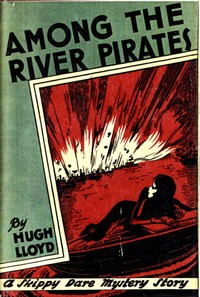
Among the River Pirates: A Skippy Dare Mystery Story — Key Ideas to Explore
Fairy Moral Tales
43,297 recorded words. 27 minutes difference from this book's estimate.
View Gutenberg source #53695
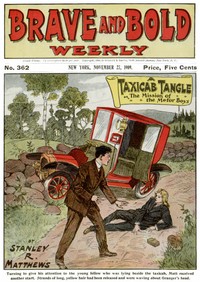
For A Taxicab Tangle; or, The Mission of the Motor Boys — Edition Insights, the stored edition analysis reports 37,222 words, 2 hr 42 min estimated reading time, and 26 detected text sections.
The text analysis averages about 13.7 words per sentence, while the detected sections provide another way to judge how the source is divided.
Project Gutenberg metadata also associates the work with “Adventure stories,” connecting these edition facts with the source record’s subject description.
Explore this collection
These alternatives are selected using recorded categories and estimated reading time.
About 189 minutes
Fairy Moral Tales
43,297 recorded words. 27 minutes difference from this book's estimate.
View Gutenberg source #53695About 208 minutes
Fairy Moral Tales
47,790 recorded words. 46 minutes difference from this book's estimate.
View Gutenberg source #55815About 225 minutes
Fairy Moral Tales
51,733 recorded words. 63 minutes difference from this book's estimate.
View Gutenberg source #52207Search stored excerpts and compare books → Choose by your preferences →
Choices use stored catalog measurements. Estimates vary with reading speed. A shared category is a catalog label, not a claim that two books have the same argument or literary quality.
Search reads excerpt text stored with this catalog and links to its associated Gutenberg record. The connection is stored in the site database; this tool does not recheck that every excerpt is word-for-word identical to that external record. Excerpt search does not cover every chapter and does not verify historical publication dates.
Catalog snapshot checked: 2026-09-26. Coverage: 90 public books, 90 available source excerpts.
Calculated from edition completeness, EPUB availability, text structure and catalogue metadata. Not a user rating.
Total of 100 points, scaled to a 2.5-5.0 range. Editions with an empty description or a missing EPUB file are not scored.
Public-domain source text
The source text is kept in the dedicated reader, separate from this catalogue record and its commentary.
The story opens with Joe McGlory, a cowboy, complaining about New York traffic in a folksy drawl: “the traffic squad has been some busy with our bubble-wagon.” His partner, Matt King—known as “Motor Matt”—is a mechanic whose expertise with gasoline engines drives the plot. The excerpt shows them imprisoned, then escaping by improvising a disguise (a white cap and apron) and bluffing a guard. Matt’s escape relies on cranking a car under fire, with “a detonation” whistling past his ear. The narrative favors short, punchy sentences and sudden reversals, typical of the dime-novel style.
The dialogue mixes Western and mechanical idioms. McGlory calls the car a “bubble-wagon” and refers to New York as a “burg.” Matt, by contrast, speaks in terse, technical commands: “Manipulating the switch, and the lever controlling the fuel supply.” This linguistic clash reflects the series’ premise—a cowboy and a motor expert teaming up. The narrator also uses vivid, compressed action verbs: “the red car leaped around the corner” and “took a sharp curve with two wheels in the air.” Such phrasing keeps the pace relentless.
The escape sequence hinges on a quick-change disguise. McGlory dons a “white cap and apron” to impersonate a servant named Paul, fooling the guard Miles long enough to slip out. The ruse is fragile—Miles sees through it immediately, leading to a “smash of dishes” and a scuffle. Matt then exploits the confusion, jumping from a window while the guard Barney is absent. These deceptions are not elaborate; they rely on speed and nerve, reflecting the dime novel’s preference for immediate, physical solutions over long-term planning.
The red car is central to the escape. Matt worries about the “switch plug,” gasoline, and oil levels—practical concerns that ground the adventure in early automotive reality. Once the engine starts, the car becomes a weapon: Matt threatens to run over a guard, and the getaway involves a “sharp curve with two wheels in the air.” Yet the vehicle also endangers the heroes; if left behind, it could be used by pursuers. This dual role—tool and liability—gives the taxicab a tension that the title promises.
Readers should note the serial’s weekly format: each chapter ends on a cliffhanger, and the action is designed for quick consumption. The slang and mechanical details are period flavor, not anachronisms. Pay attention to how the authors balance Matt’s technical competence with McGlory’s cowboy bravado—their partnership is the series’ engine. The excerpt offers a self-contained sample of the story’s rhythm: capture, trick, chase, and narrow escape.
Years at this desk, and still those Motor Boys leave me smiling—their tangles never quite escape the warm hum of loyalty between Matt and Joe. It puts me in mind of another quiet pairing, that earnest little rabbit and his sly fox friend in Little Jack Rabbit and Danny Fox — A Reader’s Guide, where even a chase can feel like a kind of fellowship.
Answer a few questions and save a private reflection on this device.