About 162 minutes
A Taxicab Tangle; or, The Mission of the Motor Boys — Edition Insights
Fairy Moral Tales
37,222 recorded words. 84 minutes difference from this book's estimate.
View Gutenberg source #53602
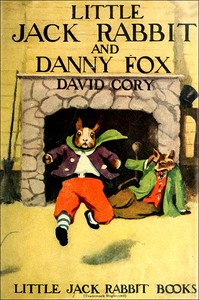
The source record for Little Jack Rabbit and Danny Fox — A Reader’s Guide measures this digital text at 17,737 words, 1 hr 18 min estimated reading time, and 39 detected text sections.
The text analysis averages about 16.0 words per sentence, while the detected sections provide another way to judge how the source is divided.
Project Gutenberg metadata also associates the work with “Animals -- Juvenile fiction,” connecting these edition facts with the source record’s subject description.
Explore this collection
These alternatives are selected using recorded categories and estimated reading time.
About 162 minutes
Fairy Moral Tales
37,222 recorded words. 84 minutes difference from this book's estimate.
View Gutenberg source #53602About 189 minutes
Fairy Moral Tales
43,297 recorded words. 111 minutes difference from this book's estimate.
View Gutenberg source #53695About 208 minutes
Fairy Moral Tales
47,790 recorded words. 130 minutes difference from this book's estimate.
View Gutenberg source #55815Search stored excerpts and compare books → Choose by your preferences →
Choices use stored catalog measurements. Estimates vary with reading speed. A shared category is a catalog label, not a claim that two books have the same argument or literary quality.
Search reads excerpt text stored with this catalog and links to its associated Gutenberg record. The connection is stored in the site database; this tool does not recheck that every excerpt is word-for-word identical to that external record. Excerpt search does not cover every chapter and does not verify historical publication dates.
Catalog snapshot checked: 2026-09-26. Coverage: 90 public books, 90 available source excerpts.
Calculated from edition completeness, EPUB availability, text structure and catalogue metadata. Not a user rating.
Total of 100 points, scaled to a 2.5-5.0 range. Editions with an empty description or a missing EPUB file are not scored.
Public-domain source text
The source text is kept in the dedicated reader, separate from this catalogue record and its commentary.
From the opening page, David Cory establishes a world defined by thresholds. Little Jack Rabbit looks out from his house in the Old Bramble Patch and sees Danny Fox peeking from behind the Big Chestnut Tree. The scene immediately sets up a pattern of surveillance and concealment that runs through the entire book. Characters are constantly watching, peeping, or hiding—the burrow entrance, the kitchen door, the edge of the patch. Movement between inside and outside is the central drama, and Cory marks each transition with a careful description of who sees whom and from where.
The Rabbit family’s home is not just a setting but an active element in the story’s structure. Cory repeatedly brings action back to the burrow, using it as a place of safety, planning, and domestic routine. Mrs. Rabbit stands watch at the kitchen door while Little Jack watches the front; later, the kitchen becomes a warm refuge where Timmy Meadowmouse receives a piece of carrot. The burrow’s interior is described with specific details—a peg for Mr. Rabbit’s fur cap, a pink gingham apron—that ground the fantasy in a recognizable home. Yet safety is never guaranteed: even inside, the family is alert, and Timmy’s nightmare proves that fear follows the characters past the threshold.
Cory structures the narrative as a series of chases, escapes, and near-misses. Danny Fox is a persistent threat, and the rabbits respond with a repertoire of defensive moves: bolting doors, keeping lookout, digging tunnels. The chase scenes are economical but vivid, often ending with a character gasping for breath. The rhythm is predictable enough to build suspense—readers know Danny Fox will reappear—but varied by the setting: a chase across the Sunny Meadow differs from one in the snow. Cory also uses the chase to introduce allies like Teddy Turtle and Timmy Meadowmouse, who each contribute a new tactic or perspective on evasion.
As the story progresses, winter transforms the meadow. Snow covers familiar paths, and characters must adapt. Timmy Meadowmouse’s attempt to tunnel home from the Old Bramble Patch is a key episode: it literalizes the theme of hidden passage and safe return. Cory describes the burrowing with physical precision—mouth full of snow, the advice not to go too far—and the tunnel becomes a fragile link between two safe zones. The snow also alters visibility: tracks are left, hiding places are buried, and the cold adds urgency. The landscape is not a backdrop but an active constraint that shapes every decision.
Cory uses repeated phrases and short songs to create a rhythmic, almost folkloric texture. Mr. Rabbit sings a verse about chickens staying in the henhouse and bunnies not going far in the snow, reinforcing the theme of staying put. Characters often echo warnings: “Don’t go too far,” “Keep a bright lookout.” These repetitions give the story a patterned, oral quality suitable for young readers. At the same time, Cory varies the formula—sometimes the warning is heeded, sometimes ignored—so that the pattern does not become mechanical. The songs also serve as mnemonic devices, marking moments of relative calm before the next threat.
Readers will notice that Cory rarely lets a character move without explaining the spatial logic: who can see whom, how far the distance is, what obstacles lie between. Paying attention to these details reveals a carefully constructed geography of danger and refuge. The book rewards a slow reading that tracks each character’s position relative to the Old Bramble Patch, the Big Chestnut Tree, and the burrow’s doors. The tension lies not in whether the rabbits will escape—the series format assures they will—but in how they will navigate the next crossing of open ground.
Reading about Little Jack Rabbit’s burrow makes me think of winters at my grandmother’s house, the same safe rooms always closing in. That feeling of space shrinking yet holding me—I found it once in Honor Bright: A Story for Girls — Story, Setting & Ideas, where a girl’s quiet corner becomes her whole world. Such stillness can feel like freedom.
Your answers remain private and are stored only in this browser.