About 225 minutes
Dick Kent, Fur Trader — Themes and Context
Fairy Moral Tales
51,733 recorded words. 7 minutes difference from this book's estimate.
View Gutenberg source #52207
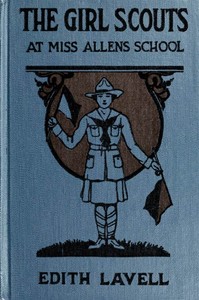
Before opening The Girl Scouts at Miss Allen's School — Background and Themes, the edition data offers a quick orientation: 53,287 words, 3 hr 52 min estimated reading time, and 46 detected text sections.
The text analysis averages about 14.8 words per sentence, while the detected sections provide another way to judge how the source is divided.
Project Gutenberg metadata also associates the work with “Schools -- Juvenile fiction,” connecting these edition facts with the source record’s subject description.
Explore this collection
These alternatives are selected using recorded categories and estimated reading time.
About 225 minutes
Fairy Moral Tales
51,733 recorded words. 7 minutes difference from this book's estimate.
View Gutenberg source #52207About 239 minutes
Fairy Moral Tales
54,934 recorded words. 7 minutes difference from this book's estimate.
View Gutenberg source #55335About 247 minutes
Fairy Moral Tales
56,582 recorded words. 15 minutes difference from this book's estimate.
View Gutenberg source #52579Search stored excerpts and compare books → Choose by your preferences →
Choices use stored catalog measurements. Estimates vary with reading speed. A shared category is a catalog label, not a claim that two books have the same argument or literary quality.
Search reads excerpt text stored with this catalog and links to its associated Gutenberg record. The connection is stored in the site database; this tool does not recheck that every excerpt is word-for-word identical to that external record. Excerpt search does not cover every chapter and does not verify historical publication dates.
Catalog snapshot checked: 2026-09-26. Coverage: 90 public books, 90 available source excerpts.
Calculated from edition completeness, EPUB availability, text structure and catalogue metadata. Not a user rating.
Total of 100 points, scaled to a 2.5-5.0 range. Editions with an empty description or a missing EPUB file are not scored.
Public-domain source text
The source text is kept in the dedicated reader, separate from this catalogue record and its commentary.
Edith Lavell's 1922 novel opens with a pointed debate about secret societies, a topic that immediately distinguishes this school story from its peers. The first chapter introduces Marjorie Wilkinson and her brother Jack, whose dismissive remark about fraternities sparks a conversation that foreshadows the book's central conflict. The catalog subjects list 'Schools,' 'Girl Scouts,' 'Girls—Societies and clubs,' and 'Boarding school students,' but the excerpts reveal that the narrative spends considerable time on sororities and their social pressures before the Girl Scout troop even forms. The Girl Scouts appear only after several chapters, and the troop's establishment is presented as an alternative to the exclusivity of sororities—a distinction the catalog does not make explicit.
The opening chapter's argument between Jack and the girls sets up a thematic tension that runs through the excerpts. Jack declares, 'Secret societies! Whew! I'm glad they don't have them at our school,' and recounts his father's tales of a windowless iron-door house. This negative portrayal of secret societies contrasts with the later introduction of the Girl Scouts, which is framed as open and constructive. The excerpts show that sorority pledging—complete with a 'stolen meeting' and a 'sorority party'—occupies the first half of the book. The Girl Scout troop, led by Miss Phillips, is presented as a remedy to the social divisions caused by sororities. The catalog's subject 'Girl Scouts—Juvenile fiction' suggests a focus on scouting, but the excerpts indicate that the book spends at least as much time on sorority life and its ethical dilemmas.
A key plot point in the excerpts involves a Latin test that determines whether Marjorie can join the Girl Scouts. The test is disrupted when Miss White receives a telegram about her mother's illness and leaves Ruth Henry to tidy the room. Ruth, who holds a grudge against Marjorie, alters Marjorie's English-to-Latin translation, changing 'gender, number, tense, or case' to ensure failure. The narrator describes Ruth's internal conflict: 'This was the opportunity she had been waiting for; if she had schemed and planned for it, it could not have been more perfect.' This act of academic sabotage is a concrete ethical test, and the excerpts suggest that the resolution involves Ruth's confession or discovery. The catalog does not mention this moral dimension, which is central to the plot.
The excerpts depict a boarding school with a clear social hierarchy: sororities, 'outsiders,' and the emerging Girl Scout troop. Details like 'the sophomore reception,' 'pledge-day,' and 'the dance' indicate a calendar of social events that reinforce cliques. The setting includes a 'cabin' where a 'ghost' appears, and a 'basket-ball game' that draws the community together. The narrator uses specific, concrete language: 'All eyes watched it describe a graceful arc and fall straight through the goal,—a perfect shot.' The school's physical environment—dormitories, classrooms, a hockey field—is sketched through action rather than description. The catalog's 'Boarding school students' subject is accurate, but the excerpts show that the school's social dynamics, not academic life, drive the story.
Readers should note that the excerpts cover only the first half of the book; the later chapters likely resolve the Latin test incident and show the Girl Scout troop's activities, such as the play and camping trip mentioned. The catalog's subjects accurately reflect the book's components but understate the prominence of sorority intrigue. Pay attention to how Lavell uses specific objects—a telegram, a pen, a Latin paper—to advance the plot and reveal character.
The rain against the window made the Latin exercises in The Girl Scouts at Miss Allen's School feel almost cozy, and I lingered over the ethical weight of that tampered test. It reminded me of another quiet reckoning with integrity, one set in a gentler era. The thought nudged me toward Honor Bright: A Story for Girls — Story, Setting & Ideas, and my afternoon dissolved into its softer light.
Capture what you thought, learned, and would like to remember.