1

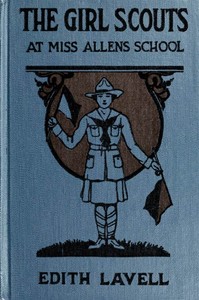
The Girl Scouts at Miss Allen's School — Background and Themes
(11 User reviews)
3457
Project Gutenberg
2017
Not confirmed
Schools -- Juvenile fiction; Girl Scouts -- Juvenile fiction; Girls -- Societies and clubs -- Juvenile fiction; Boarding school students -- Juvenile fiction
Readers of public-domain and historical texts
Project Gutenberg digital edition
en
Edition facts
Words
53,287
Reading time
232 min
Text sections
46
Before opening The Girl Scouts at Miss Allen's School — Background and Themes, the edition data offers a quick orientation: 53,287 words, 3 hr 52 min estimated reading time, and 46 detected text sections.
The text analysis averages about 14.8 words per sentence, while the detected sections provide another way to judge how the source is divided.
Project Gutenberg metadata also associates the work with “Schools -- Juvenile fiction,” connecting these edition facts with the source record’s subject description.
Source:
Project Gutenberg record #55213
Edith Lavell's 1922 school story follows Marjorie Wilkinson as she navigates boarding school life, sorority pledging, and the formation of a Girl Scout troop. The narrative contrasts secret societies with scouting ideals, while a Latin test tampering plot introduces ethical stakes.
Editorial Edition Score
4.9/5
★★★★★
★★★★★
Calculated from edition completeness, EPUB availability, text structure and catalogue metadata. Not a user rating.
How this score is calculated
- Description quality20 pts
- Title & short description10 pts
- Source metadata20 pts
- Text length15 pts
- Chapters / structure15 pts
- EPUB file integrity20 pts
Total of 100 points, scaled to a 2.5-5.0 range. Editions with an empty description or a missing EPUB file are not scored.
Edition quality
Read the Text
Ruth’s thoughts had taken an entirely different direction.
“Who are our room-mates?” she asked, as they ascended the stairs.
“Let me think,” said Miss Landis. “It’s hard to remember with so many girls, but I helped Miss Allen with the lists.” She stopped as they reached the second floor. “Oh, yes,” she continued, “you room with Ethel Todd--a sophomore. She’s a splendid girl--very popular. You’re lucky! And your room-mate,” she turned to Marjorie--“hasn’t come yet. She’s a freshman, named Lily Andrews.”
They walked down the corridor and stopped at the room which was to be Ruth’s. In answer to Miss Landis’s knock, a pretty girl about sixteen years old opened the door, disclosing an attractive interior with three large windows. Miss Landis introduced the girls.
Ethel apologized for the appearance of the room.
“You see I am just hanging the pictures and putting up the curtains,” she said. Turning to Ruth, she added, “It will be lovely to have you to help me!”
Ruth’s eyes danced; already she was fascinated by Ethel.
“Now I’ll show you to your room,” said Miss Landis to Marjorie. “I’m sorry there will be no room-mate there to welcome you, but then you can do that for her when she comes.”
As they went up another flight of stairs, Marjorie asked:
“Does she--does Ruth’s room-mate--belong to any of the sororities?”
“Yes, she belongs to _the_ sorority,” replied Miss Landis. “There’s only one, but we teachers wish there weren’t any; for it takes the girls’ minds from their lessons and their athletics, and besides, it causes a good deal of unhappiness.”
“Unhappiness!” repeated Marjorie in astonishment. “Why, I should think it would be all fun.”
“It is--for those who belong. But you see only sixteen girls--four out of each class--are chosen; and most of the other girls in the school are miserable because they aren’t asked to join. We’d like to abolish it; but some of the prominent Alumnæ who are members of the Board belong, and as long as the girls want it, they won’t hear of doing away with it.”
Miss Landis stopped before a door at the back of the building. “Here is your room,” she said.
As the teacher threw open the door, Marjorie experienced a chill of disappointment. In contrast to Ruth’s attractive room, hers was dark and small, with only one window, and the slanting roof extended down over part of the wall. And it was very bare--only the bed seemed ready for use.
“I’m sorry you’ll be alone,” said Miss Landis, “but I’ll come and take you over to Ruth’s room to go down to supper with her. I’ll be back in twenty minutes.”
It was all Marjorie could do to keep from crying. Mechanically she began to take off her hat and coat.
“I feel just like poor little Paul Dombey who was sent to that dreary school of Doctor Blimber’s--in Dickens,” thought Marjorie. “Only, I guess everything will be all right when I see Ruth again, and meet my room-mate.”
The bell for supper had already rung; in a few minutes Miss Landis returned, and they started off together for Ruth’s room. There was no answer to Miss Landis’s knock at the door.
“She must have gone down with her room-mate,” said Miss Landis. “Never mind; you can come with me. I’ll find you a place.”
The dining-room was brilliantly lighted. Seven long tables were placed in various parts of the room. The girls, most of them in light summer dresses, were crowding in and sitting down anywhere, as the regular seats were not yet assigned. Marjorie noticed that one teacher sat at each table.
“Where would you like to sit?” asked Miss Landis.
Just then Marjorie spied Ruth sitting beside Ethel Todd, at the farthest table under the window.
“I want to sit over there, near the window, with Ruth!”
“I am sorry,” said Miss Landis, “but I wouldn’t advise you to sit there without an invitation. All those girls belong to ΦΑΒ,--(Phi Alpha Beta)--the sorority--except the freshmen who have been invited there by them; and you wouldn’t want to sit there without an invitation.”
At that moment Marjorie felt all the bitterness of the outcast. “Ruth will make the sorority, and I won’t,” she thought. But she gave her attention to Miss Landis, who introduced her to some other freshmen.
Edith Lavell's 1922 novel opens with a pointed debate about secret societies, a topic that immediately distinguishes this school story from its peers. The first chapter introduces Marjorie Wilkinson and her brother Jack, whose dismissive remark about fraternities sparks a conversation that foreshadows the book's central conflict. The catalog subjects list 'Schools,' 'Girl Scouts,' 'Girls—Societies and clubs,' and 'Boarding school students,' but the excerpts reveal that the narrative spends considerable time on sororities and their social pressures before the Girl Scout troop even forms. The Girl Scouts appear only after several chapters, and the troop's establishment is presented as an alternative to the exclusivity of sororities—a distinction the catalog does not make explicit.
Secret Societies vs. Scouting Ideals
The opening chapter's argument between Jack and the girls sets up a thematic tension that runs through the excerpts. Jack declares, 'Secret societies! Whew! I'm glad they don't have them at our school,' and recounts his father's tales of a windowless iron-door house. This negative portrayal of secret societies contrasts with the later introduction of the Girl Scouts, which is framed as open and constructive. The excerpts show that sorority pledging—complete with a 'stolen meeting' and a 'sorority party'—occupies the first half of the book. The Girl Scout troop, led by Miss Phillips, is presented as a remedy to the social divisions caused by sororities. The catalog's subject 'Girl Scouts—Juvenile fiction' suggests a focus on scouting, but the excerpts indicate that the book spends at least as much time on sorority life and its ethical dilemmas.
The Latin Test and Its Consequences
A key plot point in the excerpts involves a Latin test that determines whether Marjorie can join the Girl Scouts. The test is disrupted when Miss White receives a telegram about her mother's illness and leaves Ruth Henry to tidy the room. Ruth, who holds a grudge against Marjorie, alters Marjorie's English-to-Latin translation, changing 'gender, number, tense, or case' to ensure failure. The narrator describes Ruth's internal conflict: 'This was the opportunity she had been waiting for; if she had schemed and planned for it, it could not have been more perfect.' This act of academic sabotage is a concrete ethical test, and the excerpts suggest that the resolution involves Ruth's confession or discovery. The catalog does not mention this moral dimension, which is central to the plot.
Setting and Social Structure at Miss Allen's School
The excerpts depict a boarding school with a clear social hierarchy: sororities, 'outsiders,' and the emerging Girl Scout troop. Details like 'the sophomore reception,' 'pledge-day,' and 'the dance' indicate a calendar of social events that reinforce cliques. The setting includes a 'cabin' where a 'ghost' appears, and a 'basket-ball game' that draws the community together. The narrator uses specific, concrete language: 'All eyes watched it describe a graceful arc and fall straight through the goal,—a perfect shot.' The school's physical environment—dormitories, classrooms, a hockey field—is sketched through action rather than description. The catalog's 'Boarding school students' subject is accurate, but the excerpts show that the school's social dynamics, not academic life, drive the story.
Readers should note that the excerpts cover only the first half of the book; the later chapters likely resolve the Latin test incident and show the Girl Scout troop's activities, such as the play and camping trip mentioned. The catalog's subjects accurately reflect the book's components but understate the prominence of sorority intrigue. Pay attention to how Lavell uses specific objects—a telegram, a pen, a Latin paper—to advance the plot and reveal character.
The rain against the window made the Latin exercises in The Girl Scouts at Miss Allen's School feel almost cozy, and I lingered over the ethical weight of that tampered test. It reminded me of another quiet reckoning with integrity, one set in a gentler era. The thought nudged me toward Honor Bright: A Story for Girls — Story, Setting & Ideas, and my afternoon dissolved into its softer light.
Olivia Lee
4 weeks agoCarter Baker
1 month agoLiam Jones
1 month agoLucas Ramirez
1 month agoThere are no comments for this eBook.
Reader reflection
What was your reading experience?
Capture what you thought, learned, and would like to remember.
Your progress
0
/
10
2
Was reading this book enjoyable?
3
Would you recommend this book to another reader?
4
How easy was the book to follow?
5
Was the book what you thought it would be?
6
What did you think about the pace?
7
Was the book easy to understand?
8
Did you gain anything practical from the text?
9
In one sentence, what did you learn?
10








Anthony Harris
1 month ago