1

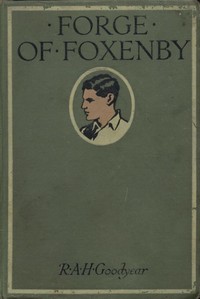
Forge of Foxenby — Story, Setting & Ideas
(11 User reviews)
1273
Project Gutenberg
2018
Not confirmed
Boarding schools -- England -- Juvenile fiction; Schoolboys -- Juvenile fiction; Rugby football -- Juvenile fiction
Readers of public-domain and historical texts
Project Gutenberg digital edition
en
Edition facts
Words
64,410
Reading time
281 min
Text sections
6
The source record for Forge of Foxenby — Story, Setting & Ideas measures this digital text at 64,410 words, 4 hr 41 min estimated reading time, and 6 detected text sections.
The text analysis averages about 14.0 words per sentence, while the detected sections provide another way to judge how the source is divided.
Project Gutenberg metadata also associates the work with “Boarding schools -- England -- Juvenile fiction,” connecting these edition facts with the source record’s subject description.
Source:
Project Gutenberg record #58533
An editorial note examining R. A. H. Goodyear's diction, dialogue, and descriptive choices in this school story, focusing on the interplay between colloquial speech, theatrical banter, and the narrator's tonal shifts.
Editorial Edition Score
4.7/5
★★★★★
★★★★★
Calculated from edition completeness, EPUB availability, text structure and catalogue metadata. Not a user rating.
How this score is calculated
- Description quality20 pts
- Title & short description10 pts
- Source metadata20 pts
- Text length15 pts
- Chapters / structure15 pts
- EPUB file integrity20 pts
Total of 100 points, scaled to a 2.5-5.0 range. Editions with an empty description or a missing EPUB file are not scored.
Edition quality
Read the Text
There was a youth behind the Foxenby posts with a muddy mark on the side of his face, and he at least knew no goal had been scored.
The first shot of the match had flashed by the upright--on the wrong side of it for St. Cuthbert's, on the right side of it for Foxenby, whose sigh of heart-felt relief was audible when their rivals' untimely cheers had died down.
"A narrow squeak, old man!" said Dick Forge, the captain of the Foxenby team, to Broome, the inside-left, selected from Holbeck's House.
"Rather!" answered Broome. "It quite turned my heart over. Their centre's got his shooting-boots on this afternoon."
"Helped by the wind, of course. It's buzzing across from goal to goal. Feel the pressure of it! Like running up against a house-side."
"We'll never get going against it, Captain. They'll be a dozen goals up at half-time."
"Fudge!" cried the captain. "They've got Lebberston and Lyon--grand old Lyon--to beat first, and Ennis after that. Throw your chest out, Broome, old man, and smile!"
Dick's laughing face was a tonic to the faint-hearted ones always. However dark the picture seemed to be, he had the happy knack of turning it to the light so that his chums could see something cheery in it.
To-day they had much need of his enthusiasm, too. By calling "heads" as the referee span a coin in the air, when it would have been much nicer had he said "tails ", he had passed the luck of the toss to the rival captain, who thankfully grabbed the chance of placing a spanking sea-breeze at the back of his team.
Hard lines indeed, you Foxenby fellows, to lose the toss in a wind like this, and on such a very important day. For you have worked your way through to the final tie of the County Schools' Cup against teams of stronger build, only to meet, in the last match, eleven sturdy youths who outweigh you almost man for man.
Forge and Lyon alone can be said to be up to the average bulk of your opponents. Ennis, your trusty goalkeeper, is certainly tall, but see how thin he looks! Almost like a third goalpost, you might say. Your forwards are fleet-footed to a man, and your halves are like terriers, ever worrying the foe.
But you can't get away from the fact that weight plays a big part in footer, and when a mass of bone and brawn has half a gale behind it to help it whenever it charges you, why, phew! you need all the pluck you can muster to pick yourselves up and start in afresh!
"St. Cuthbert's are a dandy side this season," remarked a young Cuthbertian behind the Foxenby goal. "Scored twenty-three times in the Cup-ties up to date, and never once had a goal notched against them."
"Ah, well, they'll blot their copy-books this afternoon, if never before," retorted Robin Arkness, a Foxenby Junior, who had gathered round him a little cluster of select pals, and was in a mood to blow his own side's trumpet.
"Who's going to score against them, anyhow?" asked the perky Cuthbertian youngster.
"Forge will, Broome will, perhaps even old Lyon will, from full-back, given half a chance," declared the optimistic Robin.
"Pooh! They can't even cross the half-way line," snorted the champion of St. Cuthbert's, contemptuously. "See how we're peppering your goalie all the time. Play up, Saints! Bang 'em in, boys! Oo--ooo, a goal--no, hang it, only a corner! Allow for the wind, Monty--allow for the wind!"
"You mean 'allow for the gas', don't you, kid?" asked Robin. "You're a tip-topper at scoring goals with your tongue."
Nevertheless the cocksure young Cuthbertian had every reason for his confidence. Already there were many ominous smudges of mud on the newly-whitewashed goalposts and crossbar, and a series of finely-placed corner-kicks had only been hustled away by what seemed to be desperate scrimmages of the Rugby order, with the luck on Foxenby's side.
The impartial crowd of Walsbridge townspeople, on whose ground the final tie was being played, had read wonderful accounts of the Cuthbertians' rock-like defence--it delighted them to see that these hefty youths knew also the straight route to an opponent's goal. Therefore, they began by wishing Ennis, the goalkeeper of the "Foxes", good luck, and plenty of hard work!
They flocked behind his goal, cheering him again and again as he flung himself backwards and forwards to fist away corking shots, some of which he probably knew very little about, though it just happened that his long body was always in the way. The better the goal-keeper, the more good fortune he enjoys as a rule. Forwards seem somehow magnetized into shooting where he is.
From the opening lines of Forge of Foxenby, the reader is thrust into the clamour of a football match, where the narrator’s voice mingles with the crowd’s cheers and the players’ quick exchanges. Goodyear’s prose is notably alert to the rhythms of spoken language, capturing the urgency of on-field commands and the banter of schoolboys. The dialogue is peppered with period slang—'Fudge!', 'younker', 'hop it'—and the characters often speak in a theatrical, mock-heroic register, as when Robin Arkness addresses a fellow student as 'thou scurvy knave'. This blend of colloquialism and playful archaism gives the text a distinctive verbal texture, one that rewards attention to the author’s choices in diction and tone.
Colloquial Cadences and Schoolboy Slang
Goodyear’s ear for the vernacular of Edwardian schoolboys is evident throughout the excerpts. The dialogue is studded with terms like 'grub', 'sneak', 'walloped', and 'frazzle', which ground the story in a specific social milieu. The author also uses contractions and elisions to mimic natural speech: 'What d’ye want, youngster?' and 'Sing out, quick; I’m busy just now.' These choices create a sense of immediacy and authenticity, though the slang occasionally requires glossing for modern readers. Notably, the narrator adopts a more formal tone in descriptive passages, creating a contrast that heightens the liveliness of the spoken exchanges.
Mock-Heroic Posturing and Theatrical Dialogue
Several characters, particularly Robin Arkness, adopt a deliberately inflated, quasi-medieval manner of speaking. Robin addresses his peers as 'thou pestiferous Squirm' and commands his 'Merry Men' with phrases like 'Soil not your honest hands with the watery blood of this rapscallion.' This theatrical language is a form of play, signalling the boys’ self-conscious adoption of roles from adventure stories. Goodyear uses this register to comic effect, as when Robin’s grandiloquence clashes with Peter Mawdster’s blunt demand: 'Oh, stop your high-falutin’ rot and give me back my grub.' The juxtaposition of styles underscores the tension between fantasy and reality in the boys’ lives.
Descriptive Economy and Physical Detail
Goodyear’s descriptive passages are often brief but pointed, focusing on physical details that reveal character or mood. In the opening chapter, the wind is described as 'buzzing across from goal to goal' and 'like running up against a house-side', a simile that conveys both force and resistance. Later, Dick Forge’s 'laughing face' is called 'a tonic to the faint-hearted ones', a metaphor that links his emotional state to physical health. The author also uses small gestures to imply inner states: Dick 'found himself breathing rather fast' when confronted with Robin’s autograph book. These details are economical, yet they accumulate to build a vivid sense of the characters’ inner lives.
Narrative Voice and Tonal Shifts
The narrator of Forge of Foxenby moves between a detached, reportorial style and a more involved, evaluative tone. In the football match, the narration is brisk and focused on action: 'The first shot of the match had flashed by the upright.' But when describing Dick’s mood, the narrator becomes more reflective, noting that 'Dick grew morose and silent' and that he 'had the happy knack of turning [the picture] to the light.' This tonal flexibility allows Goodyear to shift from excitement to introspection without jarring the reader. The narrator also occasionally addresses the reader directly, as in the proverb 'it is as unwise to count a goal as it is to reckon chickens still in the shell', a device that invites shared understanding.
Readers attentive to language will find in Forge of Foxenby a rich field of verbal play, from the clipped commands of the football pitch to the mock-heroic flourishes of the Merry Men. Goodyear’s dialogue is the engine of the story, driving both plot and characterisation. The excerpts suggest a writer who delights in the sound and texture of words, and who uses them to create a world that is at once familiar and heightened. Approach the text with an ear for its cadences, and the schoolyard will come alive.
That afternoon, the rain blurred the windows while Goodyear’s narrator shifted from sharp banter to quiet unease, and I kept thinking how small moments of care surface in stories about survival. Later, I found myself reaching for The Safety First Club and the Flood — Key Ideas to Explore, wondering about the same gentle responsibility. The pages felt like familiar furniture.
Owen Davis
1 month agoGabriel Wilson
1 month agoBenjamin Hall
4 weeks agoDaniel Walker
2 weeks agoThere are no comments for this eBook.
Reader reflection
How will you remember this book?
Save your reaction, strongest insight, and memorable passage.
Your progress
0
/
10
2
Did this book hold your interest?
3
Is this a title you would suggest to others?
4
How demanding did the text feel?
5
Did this book create an emotional response?
6
Could you see yourself revisiting this book?
7
Did the book deliver what you hoped for?
8
Was the book easy to understand?
9
What is the main idea you are taking away?
10



Olivia Moore
2 weeks ago