About 258 minutes
Gaudenzia, Pride of the Palio — Context and Discussion
Childrens Adventures
59,239 recorded words. 5 minutes difference from this book's estimate.
View Gutenberg source #67783
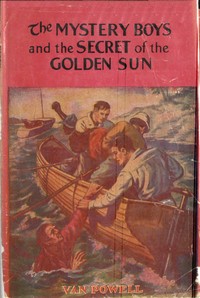
The catalog record for The Mystery Boys and the Secret of the Golden Sun — Inside the Classic provides practical reading context through 60,324 words, 4 hr 23 min estimated reading time, and 9 detected text sections.
The text analysis averages about 15.5 words per sentence, while the detected sections provide another way to judge how the source is divided.
Project Gutenberg metadata also associates the work with “Detective and mystery stories,” connecting these edition facts with the source record’s subject description.
Explore this collection
These alternatives are selected using recorded categories and estimated reading time.
About 258 minutes
Childrens Adventures
59,239 recorded words. 5 minutes difference from this book's estimate.
View Gutenberg source #67783About 272 minutes
Childrens Adventures
62,377 recorded words. 9 minutes difference from this book's estimate.
View Gutenberg source #57171About 274 minutes
Childrens Adventures
62,872 recorded words. 11 minutes difference from this book's estimate.
View Gutenberg source #59967Search stored excerpts and compare books → Choose by your preferences →
Choices use stored catalog measurements. Estimates vary with reading speed. A shared category is a catalog label, not a claim that two books have the same argument or literary quality.
Search reads excerpt text stored with this catalog and links to its associated Gutenberg record. The connection is stored in the site database; this tool does not recheck that every excerpt is word-for-word identical to that external record. Excerpt search does not cover every chapter and does not verify historical publication dates.
Catalog snapshot checked: 2026-09-26. Coverage: 90 public books, 90 available source excerpts.
Calculated from edition completeness, EPUB availability, text structure and catalogue metadata. Not a user rating.
Total of 100 points, scaled to a 2.5-5.0 range. Editions with an empty description or a missing EPUB file are not scored.
Public-domain source text
The source text is kept in the dedicated reader, separate from this catalogue record and its commentary.
The catalog lists this as a children's adventure set in Central America, but the excerpts reveal a story more concerned with memory, disguise, and layered secrets than with straightforward treasure hunting. The opening chapter introduces a scarred, bleary-eyed miner who watches the three boy protagonists—Tom, Nicky, and Cliff—as they prepare to return from a mine. The boys are not seeking adventure for its own sake; Tom is there to learn about his missing sister. The miner's appearance is immediately treated as potentially misleading: Tom cautions that a rough look does not prove ill intent.
The excerpts center on a character named Jack, a wrecked sailor who struggles to recall a drunken confession made by a man named Mort. The recovery of this memory drives the plot. Mr. Gray uses a hypnotic technique—'making suggestions almost in the way a hypnotist does'—to help Jack remember. The memory involves a 'Golden Sun,' which Jack first thinks is a mine, then a girl, and finally a cache of gold dust. The narrative treats memory as fragile and unreliable, not as a simple clue. Nicky's impulsive interruption nearly destroys Jack's confidence, showing how easily the truth can be lost.
Despite the catalog subject 'Adventure stories,' the three boys spend much of the excerpted text watching and waiting. Tom is 'cool and level headed,' Cliff cautious, and Nicky impulsive—but none of them take decisive action. They defer to adults like Mr. Gray and Bill. The most dramatic moment is Nicky's blunder, not a chase or fight. The adventure promised by chapter titles like 'Trailed by a Jaguar' and 'Where No White Men Go' is not visible in these excerpts. The boys function more as witnesses than as agents of the plot.
The catalog lists Central America as a subject, but the excerpts offer little local detail. The setting is generic: a mine, a palm tree, a hot afternoon. The only named location is Porto Bello, a real port in Panama, but it appears only in a chapter title. The characters are outsiders—American boys, a miner, a sailor—and the local population is absent except for a single reference to an 'old Indian' named Toosa, who is not present in the excerpts. The story uses Central America as a stage for a mystery about a lost gold cache, not as a place with its own culture or geography.
Readers should approach this book expecting a mystery that unfolds through conversation and recollection rather than through physical action. The excerpts suggest that the 'Golden Sun' is a puzzle with multiple possible meanings, and that the boys' role is to piece together fragments of memory. The catalog's emphasis on adventure and Central America may mislead; the actual text appears more concerned with the psychology of memory and the unreliability of appearances.
I often shelve them together, though the catalog never would. The Mystery Boys chase a golden secret through jungles, yet its heart is that scarred miner recalling what he’d buried. There’s a similar hush in The Oxbow Wizard — Story, Setting & Ideas, where the landscape itself seems to hold a memory. Both whisper that the truest treasure is what we once forgot. A quiet kinship, indeed.
Answer a few questions and save a private reflection on this device.