About 153 minutes
Wongo and the Wise Old Crow — Themes and Context
Childrens Adventures
35,031 recorded words. 6 minutes difference from this book's estimate.
View Gutenberg source #60742
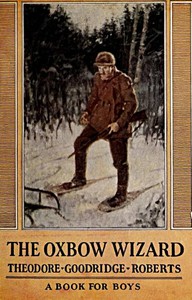
Before opening The Oxbow Wizard — Story, Setting & Ideas, the edition data offers a quick orientation: 36,402 words, 2 hr 39 min estimated reading time, and 13 detected text sections.
The text analysis averages about 16.4 words per sentence, while the detected sections provide another way to judge how the source is divided.
Project Gutenberg metadata also associates the work with “Detective and mystery stories,” connecting these edition facts with the source record’s subject description.
Explore this collection
These alternatives are selected using recorded categories and estimated reading time.
About 153 minutes
Childrens Adventures
35,031 recorded words. 6 minutes difference from this book's estimate.
View Gutenberg source #60742About 165 minutes
Childrens Adventures
37,862 recorded words. 6 minutes difference from this book's estimate.
View Gutenberg source #67689About 147 minutes
Childrens Adventures
33,773 recorded words. 12 minutes difference from this book's estimate.
View Gutenberg source #68698Search stored excerpts and compare books → Choose by your preferences →
Choices use stored catalog measurements. Estimates vary with reading speed. A shared category is a catalog label, not a claim that two books have the same argument or literary quality.
Search reads excerpt text stored with this catalog and links to its associated Gutenberg record. The connection is stored in the site database; this tool does not recheck that every excerpt is word-for-word identical to that external record. Excerpt search does not cover every chapter and does not verify historical publication dates.
Catalog snapshot checked: 2026-09-26. Coverage: 90 public books, 90 available source excerpts.
Calculated from edition completeness, EPUB availability, text structure and catalogue metadata. Not a user rating.
Total of 100 points, scaled to a 2.5-5.0 range. Editions with an empty description or a missing EPUB file are not scored.
Public-domain source text
The source text is kept in the dedicated reader, separate from this catalogue record and its commentary.
The narrative voice in The Oxbow Wizard moves between two distinct registers: a measured, almost reportorial third-person that tracks Young Dan Evans’s actions and thoughts, and a colloquial, heavily dialectal speech in dialogue. The opening chapter establishes this contrast immediately—Dan’s internal reflections are phrased in standard English (“He was smokin’ in bed!”), while his mother’s scolding is rendered in a rustic vernacular (“It’s lazy an’ it’s dangerous an’ it ain’t respectable”). This split is not merely decorative; it signals a world where the protagonist must navigate between the codes of the backwoods and the intrusions of outsiders, a tension that drives the plot.
Roberts gives each character a distinctive speech pattern that reveals background and temperament. Andy Mace’s speech is laconic and self-deprecating: “I was feelin’ kinder fretful a while back when I talked to ye that-a-way,” he says, attributing his earlier harshness to a painful knee. The one-eyed stranger’s abrupt question—“You talkin’ ’bout Andy Mace hey?”—is delivered without preamble, marking him as someone accustomed to eavesdropping and direct confrontation. Jim Conley, though absent from the excerpts, is discussed in terms of his trading habits and a suspicious bill, his character built entirely through others’ reports. The dialogue carries much of the exposition, and Roberts uses it to advance the mystery without slowing the pace.
The narrative’s tempo is governed by Dan’s practical dilemmas. In the excerpt, he faces a cascade of conflicting tasks: fetching medicine for Andy, feeding the Conley family, investigating Jim Conley, and tending his trap lines. Roberts renders this not as a frantic rush but as a deliberate weighing of options, culminating in a coin toss. The prose slows to match Dan’s deliberation (“He produced a quarter from a pocket, flipped it into the air…”) and then quickens with the sudden appearance of the one-eyed stranger. This alternation between reflective problem-solving and abrupt incident creates a rhythm that mirrors the unpredictability of frontier life.
The Oxbow region is not just a backdrop but an active force that shapes the plot’s pace. Travel times are measured in days, not hours: a two-day trip for medicine, a four-day round to spring traps. The weather, road conditions, and domestic economy dictate Dan’s schooling and his father’s farm routines. Roberts embeds these constraints in the narrative without commentary, letting the distances and seasons speak for themselves. When Dan exclaims, “It’s more’n one man can do!” the reader feels the weight of geography. The setting’s isolation also enables the mystery—the stranger’s book, the missing skins, the one-eyed man’s sudden appearance—because there are few authorities to appeal to and fewer witnesses.
Readers should attend to how Roberts uses small physical details—a cigar butt, a folded bill, a black eye-patch—to seed larger questions. The narrative rewards careful observation of what characters say and what they leave unsaid, and the pacing shifts are often signaled by a change in sentence length or a sudden piece of dialogue. Treat the setting not as picturesque decoration but as a character in its own right, one that dictates the tempo of every investigation.
The rain drummed on the window while I finished The Oxbow Wizard, struck by how quietly Roberts builds trust between his characters. That patience reminded me of another old favorite, and I found myself reaching for Jimmy Kirkland of the Cascade College Team — Themes and Context instead. Different landscape, same unhurried attention to what people don't say.
Capture what you thought, learned, and would like to remember.