About 159 minutes
The Oxbow Wizard — Story, Setting & Ideas
Childrens Adventures
36,402 recorded words. 6 minutes difference from this book's estimate.
View Gutenberg source #61911
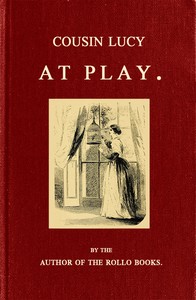
The catalog record for Cousin Lucy at Play By the Author of the Rollo Books — Text and Context provides practical reading context through 37,862 words, 2 hr 45 min estimated reading time, and 16 detected text sections.
The text analysis averages about 17.0 words per sentence, while the detected sections provide another way to judge how the source is divided.
Project Gutenberg metadata also associates the work with “Conduct of life -- Juvenile fiction,” connecting these edition facts with the source record’s subject description.
Explore this collection
These alternatives are selected using recorded categories and estimated reading time.
About 159 minutes
Childrens Adventures
36,402 recorded words. 6 minutes difference from this book's estimate.
View Gutenberg source #61911About 153 minutes
Childrens Adventures
35,031 recorded words. 12 minutes difference from this book's estimate.
View Gutenberg source #60742About 147 minutes
Childrens Adventures
33,773 recorded words. 18 minutes difference from this book's estimate.
View Gutenberg source #68698Search stored excerpts and compare books → Choose by your preferences →
Choices use stored catalog measurements. Estimates vary with reading speed. A shared category is a catalog label, not a claim that two books have the same argument or literary quality.
Search reads excerpt text stored with this catalog and links to its associated Gutenberg record. The connection is stored in the site database; this tool does not recheck that every excerpt is word-for-word identical to that external record. Excerpt search does not cover every chapter and does not verify historical publication dates.
Catalog snapshot checked: 2026-09-26. Coverage: 90 public books, 90 available source excerpts.
Calculated from edition completeness, EPUB availability, text structure and catalogue metadata. Not a user rating.
Total of 100 points, scaled to a 2.5-5.0 range. Editions with an empty description or a missing EPUB file are not scored.
Public-domain source text
The source text is kept in the dedicated reader, separate from this catalogue record and its commentary.
The marble box in Lucy's house is not made of marble but painted to look like it, and its rules are as carefully defined as its appearance. Abbott opens with a precise description of the box's location, handles, and lock, then explains that it is only opened when children are convalescent—a term he defines for his young readers. This blend of concrete detail and explicit vocabulary instruction sets the tone for the book: the narrator assumes a teaching role, guiding readers through both physical objects and abstract concepts.
Yet the narrative does not remain in this explanatory register for long. In the chapter on the Morocco Book, the pace shifts dramatically when Jenny, a young girl, takes her father's sleigh alone at night. The prose becomes taut with sensory detail—moonlight and shadow, the horse's speed, the dark shape of an approaching sleigh—and the narrator steps back to let the scene unfold.
Abbott frequently pauses the action to define words or explain concepts, a technique that gives the narrative a pedagogical rhythm. In the opening chapter, he devotes several paragraphs to the word convalescence, breaking it down syllable by syllable and linking it to the children's experience. This is not a glossary appended to the story; it is woven into the plot, as the marble box's rule depends on understanding the term. The narrator's voice is patient and precise, as when he notes that the box was called marble because it was painted marble color—a clarification that might seem obvious but reflects Abbott's commitment to unambiguous language. This explanatory mode creates a steady, unhurried pace, inviting readers to absorb information before moving forward.
In contrast to the measured opening, the sleigh ride in Chapter VI introduces a burst of speed and tension. Jenny, driving alone for the first time, speaks aloud to herself in a series of quick decisions: “If I don't go back, my father will come out to find me”. The prose mirrors her urgency with short sentences and active verbs—“She kept the reins still”, “the horse carried her safely through”. Abbott then shifts to sensory immersion: the road passes “sometimes in the moonlight, and sometimes in shadow”, and Jenny glides “like a bird”. The appearance of another sleigh introduces a moment of hesitation, but Jenny resolves to continue, and the scene ends with the travelers staring in astonishment. This episode demonstrates Abbott's ability to compress time and heighten emotion through pacing.
When Mary Jay reads from the Morocco Book, the narrative pauses again, but this time for a different purpose: to describe a picture. The illustration shows Jenny's sleigh on a snowy river, with dark woods and rocks, and the moon shining brightly. Abbott does not simply list the elements; he arranges them spatially, moving from background to foreground, from the sleigh in light to the other sleigh in shadow. The children's reactions—“How cold it looks!”—ground the description in a shared social moment. This passage slows the pace to a near standstill, inviting readers to visualize the scene alongside the characters. The shift from action to contemplation is characteristic of Abbott's method: he alternates between movement and stillness, using each to give the other weight.
Readers attentive to narrative voice will notice how Abbott modulates his tone between instructive and dramatic. The book rewards those who observe these shifts: the patient definitions of the early chapters prepare the ground for the swift, sensory passages later on. Pay attention to the moments when the narrator steps back and lets a scene speak for itself—these are the points where the story's emotional temperature rises.
Lucy’s careful sorting of her marble box reminded me of that quiet afternoon with Cousin Lucy at Play, where rules felt like small rituals of belonging. I couldn’t help turning to Watermelon Mystery at Sugar Creek — A Closer Reading afterwards—not for the plot, but for how it echoes that same unhurried attention to a child’s world, where every tiny rule or mystery holds a gentle weight.
Capture what you thought, learned, and would like to remember.