About 142 minutes
The little acrobat: a story of Italy — Text and Context
Childrens Adventures
32,574 recorded words. 5 minutes difference from this book's estimate.
View Gutenberg source #69064
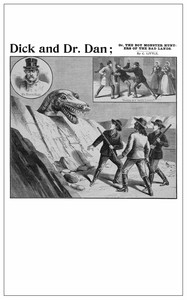
The catalog record for Dick and Dr. Dan; Or, the boy monster hunters of the Bad Lands — Context and Discussion provides practical reading context through 33,773 words, 2 hr 27 min estimated reading time, and 27 detected text sections.
The text analysis averages about 14.2 words per sentence, while the detected sections provide another way to judge how the source is divided.
Project Gutenberg metadata also associates the work with “Science fiction,” connecting these edition facts with the source record’s subject description.
Explore this collection
These alternatives are selected using recorded categories and estimated reading time.
About 142 minutes
Childrens Adventures
32,574 recorded words. 5 minutes difference from this book's estimate.
View Gutenberg source #69064About 153 minutes
Childrens Adventures
35,031 recorded words. 6 minutes difference from this book's estimate.
View Gutenberg source #60742About 159 minutes
Childrens Adventures
36,402 recorded words. 12 minutes difference from this book's estimate.
View Gutenberg source #61911Search stored excerpts and compare books → Choose by your preferences →
Choices use stored catalog measurements. Estimates vary with reading speed. A shared category is a catalog label, not a claim that two books have the same argument or literary quality.
Search reads excerpt text stored with this catalog and links to its associated Gutenberg record. The connection is stored in the site database; this tool does not recheck that every excerpt is word-for-word identical to that external record. Excerpt search does not cover every chapter and does not verify historical publication dates.
Catalog snapshot checked: 2026-09-26. Coverage: 90 public books, 90 available source excerpts.
Calculated from edition completeness, EPUB availability, text structure and catalogue metadata. Not a user rating.
Total of 100 points, scaled to a 2.5-5.0 range. Editions with an empty description or a missing EPUB file are not scored.
Public-domain source text
The source text is kept in the dedicated reader, separate from this catalogue record and its commentary.
From its opening line—a casual greeting in a Washington park—C. Little’s serial establishes a conversational, fast-paced voice. The dialogue between Dick Darrell and Charley Nicholson moves in short, punchy exchanges, with dashes and exclamations (“Hello!” “Great Scott!”) that mimic spoken rhythm. This brisk style contrasts sharply with later passages, where the narrative slows to describe underground caverns in deliberate, sensory detail: “immense stalactites hanging down like great icicles,” “a broad sheet of water, which extended off as far as the eye could penetrate into the darkness.” The shift from city banter to subterranean isolation is abrupt, and the prose adapts accordingly—trading quick repartee for longer, more atmospheric sentences.
The serial’s early chapters rely heavily on dialogue to advance the plot and define the two protagonists. Dick and Charley speak in a clipped, informal register, often interrupting each other. Their exchanges reveal not only their friendship but also their roles: Dick is the more cautious, Charley the eager one. When Dick says, “Perhaps I’m going to get the grand bounce,” Charley replies, “I hardly think that. Oh, I know! You are going to be sent off on some bone hunting expedition.” The rapid back-and-forth creates a sense of immediacy, as if the reader is overhearing a real conversation. This technique also establishes the boys’ youth and their workplace culture—the museum’s paleontological department is presented as a place of casual camaraderie and shared ambition.
Once the action moves underground, the narrative tempo changes markedly. The cavern scenes are described in longer, more measured prose, with attention to light, space, and physical sensation. Dick’s ordeal—being sucked through an underwater passage, then swimming into a vast cave—is rendered in sentences that stretch to match the scale of the setting: “Above him was the roof with immense stalactites hanging down like great icicles; the wall on his left was covered with the same glittering white formation.” The pace slows further when Dick reaches the underground lake, where “the case seemed hopeless, indeed.” This deceleration contrasts with the earlier rapid dialogue, creating a rhythm that alternates between urgency and contemplation. The shift is not merely stylistic; it mirrors the characters’ transition from familiar urban life to an alien, prehistoric world.
Little uses small, repeated motifs to anchor the reader in the physical experience of the characters. The “peculiar shout” agreed upon as a signal between Dick and Charley appears multiple times, serving as a thread of connection in the chaotic underground. Clothing also recurs as a practical concern: after emerging from the water, Dick “hurriedly undressed and wrung his wet clothing out as dry as possible,” then reflects, “I suppose I shall get my death of cold either way.” These details ground the fantastic setting in bodily reality. Similarly, Dick’s repeated collapses from exhaustion—“he sank down upon the sand and lay there, scarcely caring whether he lived or died”—emphasize the physical toll of the adventure. Such moments prevent the story from becoming purely abstract, reminding the reader that the characters are young men enduring real strain.
Readers should attend to how the serial’s serialized origins shape its structure: each chapter ends with a hook or revelation, and the pace varies accordingly. The dialogue-heavy opening chapters give way to extended descriptive passages, then to action sequences. This rhythm rewards attention to the transitions, where the narrative voice shifts most noticeably. The excerpts suggest a work that balances pulp adventure with genuine curiosity about prehistoric life, but the incomplete text leaves many questions—about the plesiosaurus, the fate of Charley, and the role of Clara Eglinton—unresolved in this edition.
Beneath the Bad Lands’ brisk dust and dialogue, there’s an unspoken loyalty—the way those two museum men watch each other’s backs. It reminds me of the same quiet devotion in Pep: The Story of a Brave Dog — Story, Setting & Ideas, where steadfastness isn’t announced, just felt. A tender echo across genres.
A brief reflection can help important ideas stay with you longer.