About 147 minutes
Dick and Dr. Dan; Or, the boy monster hunters of the Bad Lands — Context and Discussion
Childrens Adventures
33,773 recorded words. 5 minutes difference from this book's estimate.
View Gutenberg source #68698
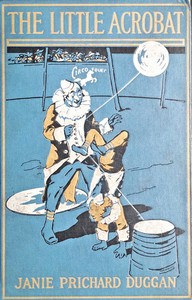
The source record for The little acrobat: a story of Italy — Text and Context measures this digital text at 32,574 words, 2 hr 22 min estimated reading time, and 20 detected text sections.
The text analysis averages about 23.7 words per sentence, while the detected sections provide another way to judge how the source is divided.
Project Gutenberg metadata also associates the work with “Boys -- Juvenile fiction,” connecting these edition facts with the source record’s subject description.
Explore this collection
These alternatives are selected using recorded categories and estimated reading time.
About 147 minutes
Childrens Adventures
33,773 recorded words. 5 minutes difference from this book's estimate.
View Gutenberg source #68698About 134 minutes
Childrens Adventures
30,661 recorded words. 8 minutes difference from this book's estimate.
View Gutenberg source #58626About 153 minutes
Childrens Adventures
35,031 recorded words. 11 minutes difference from this book's estimate.
View Gutenberg source #60742Search stored excerpts and compare books → Choose by your preferences →
Choices use stored catalog measurements. Estimates vary with reading speed. A shared category is a catalog label, not a claim that two books have the same argument or literary quality.
Search reads excerpt text stored with this catalog and links to its associated Gutenberg record. The connection is stored in the site database; this tool does not recheck that every excerpt is word-for-word identical to that external record. Excerpt search does not cover every chapter and does not verify historical publication dates.
Catalog snapshot checked: 2026-09-26. Coverage: 90 public books, 90 available source excerpts.
Calculated from edition completeness, EPUB availability, text structure and catalogue metadata. Not a user rating.
Total of 100 points, scaled to a 2.5-5.0 range. Editions with an empty description or a missing EPUB file are not scored.
Public-domain source text
The source text is kept in the dedicated reader, separate from this catalogue record and its commentary.
The July sunshine lay hot and golden over the fields of wheat on the Italian hillsides, and the deep shade of the chestnut woods along the road was more inviting than the white glare beyond. So begins Janie Prichard Duggan's 1919 children's novel, immediately establishing a sensory contrast between heat and shadow, labor and rest. The opening paragraph introduces a small brown house on wheels drawn by a queer, ill-matched team of three—a plump white horse, a large spotted horse with fierce eyes and nostrils, and a lean little brown pony with strangely twisted neck. This precise description of the mismatched team and the weary travelers sets a tone of hardship and resilience, foreshadowing the challenges faced by the circus family.
Duggan's word choice in the opening chapter is notably concrete and sensory. The road is not merely dusty but white, and the sun stands directly overhead, leaving not an inch of shadow. The horses toiled with the house-wagon, and the travelers were very tired, with poor Pietro's fever rising with every turn of the wheels. The boy Natale is introduced as a slight little fellow, with dusty lean legs and dragging feet. This accumulation of physical detail—the white dust, the dragging feet, the rising fever—creates a palpable atmosphere of exhaustion and heat. The language is plain but evocative, avoiding sentimentality while conveying the family's difficult journey. The repeated emphasis on the road's whiteness and the absence of shade reinforces the oppressive conditions, making the reader feel the glare alongside the characters.
The dialogue between Luigi and Sora Grazia in Chapter VII reveals character through contrasting speech patterns. Sora Grazia speaks in brisk, practical terms: I confess that I am surprised he has taken things so quietly. She dismisses Natale's grief as sulking, saying A child cannot sulk forever. Luigi, however, mutters under his breath, A little too quietly! and later questions, But one can die of starvation and homesickness, perhaps. His words are more reflective and empathetic, hinting at an inner conflict. The stage-like direction—Luigi, shaking his gown almost viciously—adds a physical dimension to his frustration. This exchange not only advances the plot but also establishes a subtle tension between the parents' differing attitudes toward Natale's distress, without explicitly stating their motivations.
Natale's responses to the adults are marked by silence and brief, defiant statements. When Mrs. Bishop urges him to be useful, he only shakes his head slowly and wistfully. Later, when asked about school, he remains silent. His first spoken line in the excerpt is a proud retort: Our Antonio had his name printed in Egypt and in Turkey and in Greece! I would rather be like that than have m—the sentence cuts off, but the implication is clear: he values the circus life over settled respectability. This moment of pride contrasts sharply with his earlier listlessness. Duggan uses Natale's sparse dialogue to show his internal world—his attachment to his former life and his resistance to being reshaped by others' expectations. The author trusts the reader to infer his emotions from his actions and few words.
Duggan embeds symbolic details within the setting that reflect Natale's emotional state. In Chapter VIII, Natale gazes at a rude painting on a wall of a Madonna holding a baby, which reminds him of Nonna, who was never without a child in her arms. This association links the sacred image with the nurturing figure from his past, contrasting with the cold practicality of Mrs. Bishop. The memorial tablet Mrs. Bishop points to—a stone commemorating a man born 250 years ago—is juxtaposed with the blank wall of the house where Natale now lives. The author does not explain this contrast; instead, she lets the objects speak. Natale's eyes pass carelessly from the tablet to the Madonna, showing where his true loyalty lies. These small, carefully placed details enrich the narrative without overt commentary.
Readers attentive to Duggan's craft will notice how she builds character and conflict through understatement and precise observation. The white road, the mismatched horses, the curt dialogue, and the silent boy all work together to create a story that respects its young audience's intelligence. Rather than telling readers how to feel, Duggan shows them a world of heat, dust, and quiet defiance, leaving space for interpretation. This approach makes The Little Acrobat a rewarding text for those interested in early twentieth-century children's literature that values restraint over sentiment.
There’s a particular quietness in how Duggan lets Natale’s silence speak, the way small gestures carry more weight than grand declarations. It reminded me, strangely, of the hush I felt reading Vinzi: A Story of the Swiss Alps — Reading Companion—that same sense of a landscape holding its breath around a boy who doesn’t yet know his own strength. Just a fleeting echo, really.
A brief reflection can help important ideas stay with you longer.