About 190 minutes
Mystery of the Caribbean Pearls — A Reader’s Guide
Childrens Adventures
43,494 recorded words. 3 minutes difference from this book's estimate.
View Gutenberg source #64694
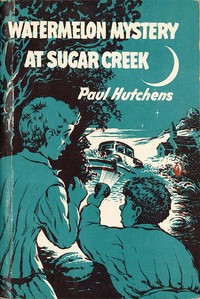
Before opening Watermelon Mystery at Sugar Creek — A Closer Reading, the edition data offers a quick orientation: 42,781 words, 3 hr 7 min estimated reading time, and 14 detected text sections.
The text analysis averages about 23.5 words per sentence, while the detected sections provide another way to judge how the source is divided.
Project Gutenberg metadata also associates the work with “Christian life -- Juvenile fiction,” connecting these edition facts with the source record’s subject description.
Explore this collection
These alternatives are selected using recorded categories and estimated reading time.
About 190 minutes
Childrens Adventures
43,494 recorded words. 3 minutes difference from this book's estimate.
View Gutenberg source #64694About 191 minutes
Childrens Adventures
43,836 recorded words. 4 minutes difference from this book's estimate.
View Gutenberg source #66921About 194 minutes
Childrens Adventures
44,394 recorded words. 7 minutes difference from this book's estimate.
View Gutenberg source #57466Search stored excerpts and compare books → Choose by your preferences →
Choices use stored catalog measurements. Estimates vary with reading speed. A shared category is a catalog label, not a claim that two books have the same argument or literary quality.
Search reads excerpt text stored with this catalog and links to its associated Gutenberg record. The connection is stored in the site database; this tool does not recheck that every excerpt is word-for-word identical to that external record. Excerpt search does not cover every chapter and does not verify historical publication dates.
Catalog snapshot checked: 2026-09-26. Coverage: 90 public books, 90 available source excerpts.
Calculated from edition completeness, EPUB availability, text structure and catalogue metadata. Not a user rating.
Total of 100 points, scaled to a 2.5-5.0 range. Editions with an empty description or a missing EPUB file are not scored.
Public-domain source text
The source text is kept in the dedicated reader, separate from this catalogue record and its commentary.
The theft of a prize watermelon sets off this installment of the Sugar Creek Gang series. The narrator, whose name is not given in the excerpts, has grown a special melon from seed ordered from the State Experiment Station, naming it Ida because 'Ida means thirsty.' The melon's disappearance triggers a search that involves the gang—Big Jim, Poetry, Little Jim, Circus, and Dragonfly—and introduces tensions between the boys and a group of girl campers who have 'invaded' their woods.
The excerpts reveal a story rooted in specific details of farm life: the iron pitcher pump, the soil testing, and the careful watering of the melon vine. The narrator's voice is colloquial and observant, noting the behavior of grasshoppers and Monarch butterflies with the same attention he gives to the mystery.
The narrator's habit of naming things—'giving names to nearly every living thing around our farm'—extends to the stolen watermelon, called Ida. This practice reflects a worldview where the natural world is personal and worthy of attention. The excerpts show careful observation: the melon's 'oblong, dark green' appearance, the 'circular trough' for watering, and the fact that a watermelon is 'over ninety-two per cent water.'
Similarly, the boys notice the 'short-horned grasshoppers' making 'funny little rattling sounds' and the Monarch butterfly's migration. The narrator describes the Monarch larva as 'a long greenish-yellow caterpillar with crow-black rings around it all along its body.' These details ground the story in a specific rural landscape and a boy's curiosity about the natural world.
The Sugar Creek Gang is presented as a close-knit group with distinct traits: Big Jim has an 'almost mustache,' Poetry is 'fat' and mischievous, Little Jim has a 'mouselike innocent face,' Circus a 'monkey-shaped face,' and the narrator a 'freckle-faced face.' Their meeting under the 'Little-Jim tree' shows a routine of lying 'in a different direction like we nearly always do.'
A new tension appears with the arrival of girl campers. The narrator feels that 'girls in our woods would be a lasso on a boy's fun,' preventing them from 'racing wildly among the trees playing leapfrog.' This contrast between the boys' usual freedom and the perceived constraint of girls' presence adds a social layer to the adventure.
The narrator's first-person voice is colloquial and direct, using phrases like 'as you maybe know' and 'on account of.' He describes the pump's 'squeaking times' and the heat waves 'dancing above the fields.' The language is informal but precise, mixing farm terminology with boyish enthusiasm.
There is a subtle humor in the narrator's asides, such as his thought about offering Big Jim 'Pop's discarded' razor strap, noting that 'there really wasn't any sense in having a piece of leather like that lying around our house.' The voice consistently reflects a child's perspective, with observations that are earnest and occasionally wry.
Readers approaching this book should expect a mystery that unfolds through the eyes of a farm boy, with the natural environment as a constant presence. The excerpts suggest a story where the theft is a catalyst for adventure, but the real texture lies in the details of daily life and the dynamics among the gang. The Christian elements, indicated by the catalog subject, are not prominent in these excerpts but may emerge later.
That rainy afternoon, I lingered over the Sugar Creek boys tracing muddy footprints past the melon patch, noticing how patiently they watched the world before acting. Their quiet attentiveness reminded me, for no clear reason, of another creature’s patient watching—a cinnamon cub learning his forest. Later, I found myself rereading Chinook, the Cinnamon Cub — Text and Context, and the two felt like the same slow, curious weather inside me.
Your answers remain private and are stored only in this browser.