1

Gaudenzia, Pride of the Palio — Context and Discussion
(6 User reviews)
1196
Project Gutenberg
2022
Not confirmed
Palio di Siena (Festival) (Siena, Italy) -- Juvenile fiction; Horse racing -- Juvenile fiction; Siena (Italy) -- Juvenile fiction
Readers of public-domain and historical texts
Project Gutenberg digital edition
en
Edition facts
Words
59,239
Reading time
258 min
Text sections
8
This digital edition of Gaudenzia, Pride of the Palio — Context and Discussion is described by source-level measurements including 59,239 words, 4 hr 18 min estimated reading time, and 8 detected text sections.
The text analysis averages about 12.7 words per sentence, while the detected sections provide another way to judge how the source is divided.
Project Gutenberg metadata also associates the work with “Palio di Siena (Festival) (Siena, Italy) -- Juvenile fiction,” connecting these edition facts with the source record’s subject description.
Source:
Project Gutenberg record #67783
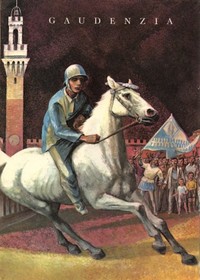
Marguerite Henry's account of Giorgio Terni and the half-bred Arabian mare Gaudenzia, set against the Palio di Siena. The narrative shifts from a planned plot to the real story of a peasant boy and a horse battling fate, with detailed observations on language, voice, and pacing.
Editorial Edition Score
4.7/5
★★★★★
★★★★★
Calculated from edition completeness, EPUB availability, text structure and catalogue metadata. Not a user rating.
How this score is calculated
- Description quality20 pts
- Title & short description10 pts
- Source metadata20 pts
- Text length15 pts
- Chapters / structure15 pts
- EPUB file integrity20 pts
Total of 100 points, scaled to a 2.5-5.0 range. Editions with an empty description or a missing EPUB file are not scored.
Edition quality
Read the Text
Giorgio was only half listening; he was on a big-going horse, sailing right over the cone of Mount Amiata.
If the swineherd and his donkey had planted a seed in Giorgio's mind, it was the Umbrella Man who made it grow. He came yodeling into Monticello one misting morning three months later.
"_Om-brel-lai-o-o-o!_" His voice rang out strong and clear as the bell in the church tower. "_Om-brel-lai-o-o-o!_ I doctor the broken ribs! I patch and mend! Pots and pans, and china, too. _Om-brel-lai-o-o-o!_" And he strung out the word until it rolled and bounced from house to house.
Shutters flew open, heads popped out of windows. A crock of geraniums fell with a crash on the cobblestones below. Children danced for joy, old men brandished their canes like batons. Giorgio, who had been filling pitchers at the public fountain, ran for home, spilling the water as he flew.
"_Mammina!_" he cried as he burst into the kitchen. "He is here! Uncle Marco, the Umbrella Man!"
His mother turned away from the stove, smiling. It was good for a change to have Giorgio seem more boy than man. She took from the opposite wall, next to the family's hats and caps, an enormous green umbrella with a loose hanging fold made by a broken rib. "The tinker man works magic if he can fix this," she laughed.
In a flash Giorgio was at the door, umbrella in hand.
"Wait, son! Wait!" She looked at the eager boy and quickly counted in her mind the pieces of money in the sugar pot--the soldi and the lire. Yes, if she carried the big red hen and one or two rabbits to market, there would again be the same money in the pot.
She went to the end of the narrow room that served as kitchen, dining, and living room. Opening the bottom doors of a tall cupboard, she took out the broken pieces of a bake dish. It was the one, Giorgio saw, that he had clumsily dropped on the stone floor. Next she counted out a hundred lire.
"Now then," she said, putting the money and the broken dish into his hands, "go quickly. With the umbrella _and_ the bake dish to mend, you can ask more questions than anyone who brings just the umbrella. You are happy, no?"
Thinking of the cost, Giorgio looked at his mother in astonishment. Ever since the incident of the donkey she had tried in little ways to make up for his sorrow. She had fried crispy hot _fritelle_ for him when it wasn't even a feast day. And only last night he had found under his pillow the last piece of nougat left from Christmas. Now this joy! For it was Uncle Marco's rule that whoever brought him the most work could ask the most questions.
"_Si! Si!_" he answered, kissing her soundly on the cheek. Then he threw back his head, and whinnying like a King Horse ran joyously out of the house.
On the edge of the public fountain, where three narrow lanes come together, the Umbrella Man sat perched like some Robin Hood alighted only for the moment. He wore a brimmed hat with the tail feathers of a cock pheasant stuck through the felt. His shoes were brown leather curled upward at the toes, and the soles were of wood, rubbed shiny. When he lifted his arms one could tell that his jacket had once been bright green. Now it was powdered by dust--not gray dust, not brown, but tawny red--testimony to long days of walking the hills of Tuscany.
Yet with all his traveling the Umbrella Man showed no sign of weariness. His eyes, dark and beady, sparkled in delight, as if this were a day he had long awaited, as if it held a special quality, rare and magical.
"_Buon giorno! Buon giorno!_" He opened wide his arms to welcome his friends who came laughing and breathless to greet him. One other boy brought a sagging umbrella, and a girl carried a pitcher with a broken snout. They, with Giorgio, placed their crippled possessions at his feet, like precious offerings laid before a god.
Before starting to work, Uncle Marco looked from face to face, beaming. He was actor as well as tinker. He had certain little curtain-raiser habits to whet the excitement. First he made a ritual of taking off his hat, running his fingers over the bright glinting feathers, and putting it back on again at a rakish angle. Then while his audience watched in growing impatience, he took a copper mug from his pocket, and let the fountain water flow into it. He drank long and heartily, sucking the water through his ragged red whiskers with a loud hissing sound.
Marguerite Henry's foreword immediately signals a shift in narrative approach: she admits that her initial imagined plot—a fearless boy defying ancient rules—was discarded after witnessing the real Palio. Instead, the story that emerged follows Giorgio Terni and the mare Gaudenzia as "pawns of fate." This editorial note examines how Henry's language, narrative voice, and changes in pace reflect that shift from invention to observed reality.
From Imagined to Observed: The Foreword's Pivot
The foreword is a rare moment where the author directly addresses her own process. Henry writes that she "had to scuttle my preconceived plot" after facing the real race. This confession sets up a tension between the fictional and the factual that runs through the book. The language here is direct and self-critical: "no rider, no matter how brave, would ever defy the ancient rules." The voice is that of a reporter correcting her own assumptions. This opening section establishes a documentary tone that contrasts with the more lyrical passages later, where Giorgio's emotions take over.
Giorgio's Voice: Testing Names and Whistling Tunes
Henry gives Giorgio a distinct interior voice. When he first hears the mare's name, he "slowly tested it on his tongue." The act of speaking the name becomes a moment of happiness. Later, as he walks to Doctor Celli's villa, he whistles "about the common road to glory" and the notes come "so light and fast he could hardly keep up with them." These small details—the testing of a word, the speed of a whistle—reveal character through sensory action rather than exposition. The narrative pace quickens with Giorgio's excitement: he "half ran" up the hill, and the sentences shorten as he worries about the doctor being a late riser. The voice remains close to Giorgio's perspective, using free indirect discourse to convey his hopes and fears.
Pacing the Encounter: The Stable Scene's Deliberate Rhythm
In Chapter XVIII, the pace slows dramatically when Giorgio enters the stable. The description is sparse: "the ribs showing, the mantle harsh." The stall smells "of cold earth and hay and dung." Henry uses short, clipped sentences to mirror Giorgio's stillness. The mare is "electric with curiosity," and Giorgio stands "motionless, making no sound." This pause contrasts with the earlier hurried walk. The scene builds tension through restraint—no dialogue, only observation. The narrative voice here is almost clinical, focusing on physical details. This shift in pace underscores the gravity of the moment: Giorgio is alone with the injured mare for the first time, and the story's emotional weight rests on this quiet encounter.
Henry's narrative voice moves fluidly between documentary precision and intimate character focus. Readers attentive to pacing will notice how the foreword's brisk confession gives way to Giorgio's measured, sensory world. The stable scene, in particular, rewards close reading for its deliberate rhythm and restrained language. These shifts are not arbitrary; they reflect the author's own journey from imagined plot to lived story.
Reading about Giorgio and Gaudenzia, I kept thinking how place itself becomes a kind of devotion. The same quiet pull I felt in Siena surfaces again in Vinzi: A Story of the Swiss Alps — Reading Companion, though the mountains hold it differently. Both books feel less like stories and more like remembered weather, lingering long after the page turns.
There are no comments for this eBook.
Reader reflection
Take a moment to reflect on this book
Create a short personal record of your experience with this book.
Your progress
0
/
10
2
How did the book work for you overall?
3
How likely are you to recommend this book?
4
How easy was the book to follow?
5
Did you relate to its people, ideas, or situations?
6
How useful did the reading feel?
7
How original did the book feel?
8
Did the book meet your expectations?
9
What is the main idea you are taking away?
10


Owen Green
1 month ago