1

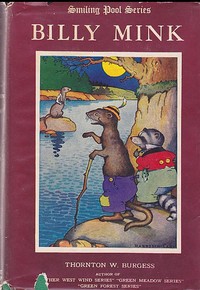
Billy Mink — A Closer Reading
(8 User reviews)
2136
Project Gutenberg
2021
Not confirmed
Friendship -- Juvenile fiction; Minks -- Juvenile fiction; Forest animals -- Juvenile fiction; Robbers and outlaws -- Juvenile fiction
Readers of public-domain and historical texts
Project Gutenberg digital edition
en
Edition facts
Words
24,608
Reading time
107 min
Text sections
4
For Billy Mink — A Closer Reading, the stored edition analysis reports 24,608 words, 1 hr 47 min estimated reading time, and 4 detected text sections.
The text analysis averages about 15.9 words per sentence, while the detected sections provide another way to judge how the source is divided.
Project Gutenberg metadata also associates the work with “Friendship -- Juvenile fiction,” connecting these edition facts with the source record’s subject description.
Source:
Project Gutenberg record #65308
Thornton W. Burgess's Billy Mink follows the sharp-eyed mink as he uncovers traps, warns forest friends, and tracks a rat gang from barn to farmhouse. The story moves between Laughing Brook and human buildings, using snow and scent trails to structure the chase.
Editorial Edition Score
4.6/5
★★★★★
★★★★★
Calculated from edition completeness, EPUB availability, text structure and catalogue metadata. Not a user rating.
How this score is calculated
- Description quality20 pts
- Title & short description10 pts
- Source metadata20 pts
- Text length15 pts
- Chapters / structure15 pts
- EPUB file integrity20 pts
Total of 100 points, scaled to a 2.5-5.0 range. Editions with an empty description or a missing EPUB file are not scored.
Edition quality
Read the Text
now there was no danger. He could get that fish. He did get it. He got it and ate it right there. Then he turned and ran out the way he had entered. Somehow that fish had tasted the best of any fish he ever had eaten. It was because he had outwitted the trapper.
CHAPTER IV BILLY FINDS SOME QUEER FENCES
When something new and strange you find, Watch out! To danger be not blind. _Billy Mink._
The trouble with a great many people is that they are heedless. When they find something new and strange they forget everything but their curiosity. Because of this they walk right straight into trouble. It happens over and over again.
But Billy Mink isn’t this kind of a person. My, my, I should say not. He never has been. If he had he would have lost that beautiful, brown coat of his long ago and there would be no Billy Mink. Billy has his share of curiosity, but with it he possesses a great big bump of suspicion. When he finds anything new and strange he wants to learn all about it. But right away he is suspicious of it.
After he had discovered the trap set for him at the entrance to one of his favorite holes, and had fooled the trapper by getting the fish the trapper had placed in that hole, Billy went on up the Laughing Brook to see what else he could discover. Not very far above that place there was a steep bank on each side of the Laughing Brook. Along the foot of each bank was a narrow strip of level ground between the bank and the water. You see, at this season of the year, the water in the Laughing Brook was low.
When Billy came to this place he discovered something queer. It was a little fence. It ran from the foot of the bank straight out into the Laughing Brook to where the water became deep. Midway in this little fence was a gateway just big enough to slip through comfortably. Billy looked across to the other side of the Laughing Brook. Over there was another little fence just like this one, and that little fence had an opening in it.
“Huh!” said Billy. “Huh! These fences are something new. They were not here when I came down the Laughing Brook yesterday. I wonder what they are for. If it were not for those two little openings I would have either to climb the bank or swim around the ends of those fences, and that would be bothersome. I can go through that little opening there as easily as rolling off a log. But I’m not going to do it. No, sir, I’m not going to do it. There is something wrong about these fences. They look to me as if they were built just to make me go through one of those little gateways. If that’s the case, I’m not going to do it.”
So Billy plunged into the Laughing Brook and swam out into the deep water around the end of the little fence. Then very carefully he approached the little opening from that side. The more he looked at it, the less he liked it. Right in the middle of that little opening were some wet, dead leaves. “Ha, ha!” said Billy. “Another trap!”
CHAPTER V A MOONLIGHT VISIT
Do a good turn for another, Proving thus you are his brother. _Billy Mink._
Billy Mink was just plain mad. He had begun to get that way when he found the trap set at the entrance to one of his favorite holes. But when he found a little fence on each side of the Laughing Brook right across where he was in the habit of running when traveling up and down the Laughing Brook, and in the middle of each little fence an opening with a trap in it, Billy lost his temper completely. He ground his teeth and his eyes grew red with anger. You see, he knew that those traps had been set especially for him.
“I despise a trapper,” snarled Billy. “Yes, sir, I despise a trapper. It is bad enough to be hunted, but then a fellow does have some chance. He knows where the danger is and what to look out for. If he is reasonably smart he can fool the hunter. But traps don’t give a fellow any chance at all. They are sneaky things. They jump up and grab a fellow without any warning at all. I hate traps, and I hate trappers! I wonder if I can find any more traps along the Laughing Brook.”
Billy Mink opens with a couplet warning that “the stranger and the unknown must / Be always looked on with distrust,” a motto that governs the entire narrative. The story is built around Billy’s suspicion: first of a human trapper’s metal traps, then of a gang of rats who have taken over a big barn. Burgess structures the plot as a series of investigations, each triggered by Billy’s sharp senses—his eyes, ears, and especially his nose. The setting shifts from the Laughing Brook and Green Forest to the farmyard, the henhouse, and finally the farmhouse itself, creating a layered geography of danger and discovery.
From Brook to Barn: Shifting Ground
The narrative moves through distinct territories, each with its own rules. Early chapters place Billy along the Laughing Brook, where he is the keenest observer of all the little people. When he discovers a trap, the action shifts to the human farm. The barn becomes a new world: a “queer fence” (a wire trap) and a rat gang that operates like a robber band. Burgess marks each transition with a change in Billy’s behavior—he becomes more cautious, more calculating. The snow that falls in chapter 23 erases all tracks, forcing Billy to rely on memory and guesswork. This geographical layering gives the story a clear, episodic structure while maintaining a single thread of pursuit.
Scent, Snow, and Silence
Burgess uses sensory details—especially smell and sound—to drive the plot. Billy’s “wonderful nose” is his primary tool; he follows trails, detects hidden rats, and recognizes danger by scent alone. When the rats vanish, the snow covers their footprints and “there was no scent for Billy to follow.” The absence of sound is equally telling: in the empty barn, Billy hears “not the squeak of a single voice.” These sensory cues create a rhythm of presence and absence, guiding both Billy and the reader. The recurring image of the “spotlessly white” snow blanketing the landscape emphasizes how quickly a trail can be lost, and how easily enemies can hide.
The Rat Gang as a Collective Antagonist
Unlike Billy, who acts alone, the rats are a coordinated group led by a “wise, gray old leader.” Burgess portrays them as a “gang of robbers” who are “ugly, dirty, and of no account.” They plan collectively, hold meetings, and decide to fight or flee as a unit. Their movement from barn to farmhouse is a strategic retreat, calculated to exploit Billy’s fear of humans. This collective antagonist contrasts with Billy’s solitary, improvisational style. The rats’ ability to organize makes them a persistent threat, and their leader’s cunning—knowing that Billy “would hesitate a long time about actually entering the house”—adds a layer of psychological tension to the chase.
The Farmer’s Role: From Threat to Ally
Initially, the farmer is an offstage figure whose traps threaten Billy. But as the rats invade the farmhouse, the farmer becomes a witness and then an ally. In chapter 28, “The Farmer Guesses the Truth,” he begins to understand that Billy is hunting the rats. By chapter 29, he actively makes friends with Billy, offering food and shelter. This shift transforms the human world from a place of danger to a source of aid. Burgess keeps the farmer’s perspective limited—we see only his actions, not his thoughts—but his presence changes the stakes. Billy’s wariness of man is overcome by the greater threat of the rats, creating an uneasy but effective partnership.
Readers will notice that Burgess rarely lets Billy pause. The story is built on movement: from brook to barn, from barn to henhouse, from henhouse to farmhouse. Each chapter ends with a decision to go somewhere else. Pay attention to the couplets that open each chapter—they often foreshadow the moral or outcome. The illustrations by Harrison Cady, though not reproduced here, originally reinforced the sense of place and action. This is a story best read as a chase, with Billy’s nose as the compass.
That rainy afternoon, I kept returning to Billy Mink’s patient tracking of scent trails through snow and stranger doorways. It made me think how animals navigate human spaces, and humans navigate wild ones—which is how I stumbled onto The Bird Boys' Aeroplane Wonder; Or, Young Aviators on a Cattle Ranch — Edition Insights, almost without deciding to. Same quiet watchfulness, just lifted off the ground.
Madison Allen
1 month agoEmma Miller
1 month agoIsabella Perez
1 month agoEvelyn Jones
1 month agoThere are no comments for this eBook.
Reader reflection
Before you leave, reflect on the book
Use these questions to collect your thoughts before moving on.
Your progress
0
/
10
2
How did the book work for you overall?
3
Would you recommend this book to another reader?
4
How easy was the book to follow?
5
What did you appreciate most?
6
Did the story or argument move comfortably?
7
Was the book what you thought it would be?
8
Would you start a conversation about this book?
9
What changed or sharpened your thinking?
10
Anthony Walker
1 month ago