1

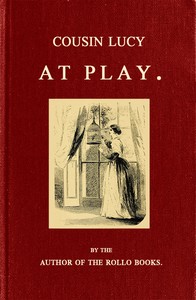
Cousin Lucy at Play By the Author of the Rollo Books — Text and Context
(9 User reviews)
2118
Project Gutenberg
2022
Not confirmed
Conduct of life -- Juvenile fiction; Children -- Conduct of life -- Juvenile fiction; Siblings -- Juvenile fiction; Amusements -- Juvenile fiction; Games -- Juvenile fiction; Reading -- Juvenile fiction
Readers of public-domain and historical texts
Project Gutenberg digital edition
en
Edition facts
Words
37,862
Reading time
165 min
Text sections
16
The catalog record for Cousin Lucy at Play By the Author of the Rollo Books — Text and Context provides practical reading context through 37,862 words, 2 hr 45 min estimated reading time, and 16 detected text sections.
The text analysis averages about 17.0 words per sentence, while the detected sections provide another way to judge how the source is divided.
Project Gutenberg metadata also associates the work with “Conduct of life -- Juvenile fiction,” connecting these edition facts with the source record’s subject description.
Source:
Project Gutenberg record #67689
Jacob Abbott's 1857 children's book follows Lucy and her brother Royal through play, errands, and small adventures. The narrative voice blends direct instruction with vivid scene-setting, as seen in the marble box rules and Jenny's solo sleigh ride. Language shifts between explanatory passages and dramatic moments.
Editorial Edition Score
4.8/5
★★★★★
★★★★★
Calculated from edition completeness, EPUB availability, text structure and catalogue metadata. Not a user rating.
How this score is calculated
- Description quality20 pts
- Title & short description10 pts
- Source metadata20 pts
- Text length15 pts
- Chapters / structure15 pts
- EPUB file integrity20 pts
Total of 100 points, scaled to a 2.5-5.0 range. Editions with an empty description or a missing EPUB file are not scored.
Edition quality
Read the Text
PTER I. THE MARBLE BOX, 9
CHAPTER II. METAPHYSICS, 26
CHAPTER III. STORIES, 42
CHAPTER IV. THE RIDE TO TOWN, 56
CHAPTER V. THE GYPSY PARTY, 72
CHAPTER VI. THE MOROCCO BOOK--THE LONELY SLEIGH-RIDE, 90
CHAPTER VII. MARY JAY’S SUNDAY SCHOOL, 108
CHAPTER VIII. THE PRESENT, 126
CHAPTER IX. A FRIGHT, 138
CHAPTER X. ROYAL A PROTECTOR, 156
CHAPTER XI. THE DICTIONARY, 172
There was a box, or chest, of a somewhat singular character, in the house where Lucy lived; it was called the _marble box_. It was not really made of marble; it was made of wood; but then it was painted marble color, and that was the reason why it was called the marble box.
The marble box had books and playthings in it. It was pretty large, and so it would hold a considerable number. There was a handle at each end, and when Lucy took hold of one handle, and Royal, her brother, of the other, the box was just about as much as they could conveniently carry. The place where the marble box was usually kept, was under a table in the back chamber entry, not far from the head of the stairs.
There was a lock to the marble box, and Lucy’s mother kept the key. She tied a piece of blue ribbon to the key to mark it, and she kept it hung up under the mantel shelf in her room.
The rule of the marble box was this--that it never was to be opened except when the children were sick,--or, rather, when they were convalescent. When children are attacked with sickness, they do not generally, for a time, wish for any playthings. But, then, when the disease is once subdued, and the pain, or the unpleasant feelings, whatever they may be, have disappeared,--then there is a period, while the patient is recovering his health and strength, which is called the period of _convalescence_. Now, during convalescence, children are more in need of playthings to interest and occupy their minds than at any other time.
There are various reasons why this is so. In the first place, they cannot usually be allowed to go out of doors; for, after such an attack of sickness, it generally takes some time for the system to become restored to its usual state, so as to bear safely the ordinary exposures. Thus, by being confined to the house, the child is cut off from some of his sources of enjoyment, which makes it more necessary that he should have agreeable books and playthings.
Then, besides, during convalescence, the mind is not generally in a proper state to engage in study, or in any of the usual duties of life. This is peculiarly the case if the sickness has been severe. We feel weak, and are easily fatigued, and exhausted with exertion, either of mind or body. Consequently the ordinary duties of life are usually suspended during convalescence, and this leaves a large portion of time unoccupied. It is always difficult for mothers to find the means to occupy this time pleasantly, in the case of the convalescence of their children.
There is one more reason why it is desirable to have interesting books and playthings for children, when they are in a state of convalescence; and that is, that the mind is in such a state that it is in some respects more difficult to be interested and amused then than at other times. When recovering from sickness, there is often a kind of lassitude and weariness, which makes the patient indisposed to be long occupied in any one way. Occupations and amusements, which would please him very much at some times, fail altogether now. The common books and playthings, which he is accustomed to use at other times, do not afford him much pleasure now. He very soon gets tired of them.
For these reasons, Lucy’s mother had often found it very difficult to provide the means of amusing her, and occupying her mind, when she was sick; and still more difficult to do this in the case of Royal. So she told them, one day, that she meant to have a trunk to keep books and playthings in, expressly for this purpose. She looked about the house for a trunk, but she could not find any one, which was not in use. At last, however, she met with this wooden box or chest, which was about as large as a trunk; and she said that that would do very well indeed. Royal helped her to bring it down stairs.
The marble box in Lucy's house is not made of marble but painted to look like it, and its rules are as carefully defined as its appearance. Abbott opens with a precise description of the box's location, handles, and lock, then explains that it is only opened when children are convalescent—a term he defines for his young readers. This blend of concrete detail and explicit vocabulary instruction sets the tone for the book: the narrator assumes a teaching role, guiding readers through both physical objects and abstract concepts.
Yet the narrative does not remain in this explanatory register for long. In the chapter on the Morocco Book, the pace shifts dramatically when Jenny, a young girl, takes her father's sleigh alone at night. The prose becomes taut with sensory detail—moonlight and shadow, the horse's speed, the dark shape of an approaching sleigh—and the narrator steps back to let the scene unfold.
Explanatory Voice and the Definition of Terms
Abbott frequently pauses the action to define words or explain concepts, a technique that gives the narrative a pedagogical rhythm. In the opening chapter, he devotes several paragraphs to the word convalescence, breaking it down syllable by syllable and linking it to the children's experience. This is not a glossary appended to the story; it is woven into the plot, as the marble box's rule depends on understanding the term. The narrator's voice is patient and precise, as when he notes that the box was called marble because it was painted marble color—a clarification that might seem obvious but reflects Abbott's commitment to unambiguous language. This explanatory mode creates a steady, unhurried pace, inviting readers to absorb information before moving forward.
Sudden Acceleration in the Sleigh Ride
In contrast to the measured opening, the sleigh ride in Chapter VI introduces a burst of speed and tension. Jenny, driving alone for the first time, speaks aloud to herself in a series of quick decisions: “If I don't go back, my father will come out to find me”. The prose mirrors her urgency with short sentences and active verbs—“She kept the reins still”, “the horse carried her safely through”. Abbott then shifts to sensory immersion: the road passes “sometimes in the moonlight, and sometimes in shadow”, and Jenny glides “like a bird”. The appearance of another sleigh introduces a moment of hesitation, but Jenny resolves to continue, and the scene ends with the travelers staring in astonishment. This episode demonstrates Abbott's ability to compress time and heighten emotion through pacing.
Pictorial Description and Group Response
When Mary Jay reads from the Morocco Book, the narrative pauses again, but this time for a different purpose: to describe a picture. The illustration shows Jenny's sleigh on a snowy river, with dark woods and rocks, and the moon shining brightly. Abbott does not simply list the elements; he arranges them spatially, moving from background to foreground, from the sleigh in light to the other sleigh in shadow. The children's reactions—“How cold it looks!”—ground the description in a shared social moment. This passage slows the pace to a near standstill, inviting readers to visualize the scene alongside the characters. The shift from action to contemplation is characteristic of Abbott's method: he alternates between movement and stillness, using each to give the other weight.
Readers attentive to narrative voice will notice how Abbott modulates his tone between instructive and dramatic. The book rewards those who observe these shifts: the patient definitions of the early chapters prepare the ground for the swift, sensory passages later on. Pay attention to the moments when the narrator steps back and lets a scene speak for itself—these are the points where the story's emotional temperature rises.
Lucy’s careful sorting of her marble box reminded me of that quiet afternoon with Cousin Lucy at Play, where rules felt like small rituals of belonging. I couldn’t help turning to Watermelon Mystery at Sugar Creek — A Closer Reading afterwards—not for the plot, but for how it echoes that same unhurried attention to a child’s world, where every tiny rule or mystery holds a gentle weight.
Jack Hall
1 month agoMia Baker
1 month agoHarper Wilson
2 weeks ago-

Kevin Jimmy Bradley - 1 month ago
This charming Victorian-era story captures the innocent joy of childhood play perfectly. Cousin Lucy's adventures are wholesome yet engaging, with a gentle moral lesson woven seamlessly into the narrative. Fans of classic children's literature will appreciate the period details and the sweet relationship dynamics. It's a delightful read that transports you to a simpler time and is perfect for bedtime storytelling. -
Erin Clay - 1 month ago
Cousin Lucy At Play is a classic children's tale that offers a nostalgic glimpse into 19th-century amusements. The writing is accessible and the characters are likable, making it a good read for young ones. However, the pacing feels a bit slow by modern standards, and some cultural references may require explanation for today's kids. Still, it's a decent addition to any child's library. -
Jeffrey Hernandez - 2 weeks ago
While this book holds historical value, it feels antiquated and slow-moving for contemporary young readers. The plot lacks significant conflict, and the moralizing tone can be heavy-handed. There are more engaging options available that capture children's imagination better. Unless you're specifically interested in early children's literature, this might not be worth your time.
Reader reflection
What was your reading experience?
Capture what you thought, learned, and would like to remember.
Your progress
0
/
10
2
Did this book hold your interest?
3
Would you encourage someone else to read it?
4
What was the reading difficulty like?
5
How strongly did the book affect you emotionally?
6
How clear did the writing feel?
7
Did anything about the book feel genuinely new?
8
How well did it match your expectations?
9
What is the main idea you are taking away?
10



William Garcia
1 month ago