1

Don Hale Over There — Reading Notes
(6 User reviews)
1099
Project Gutenberg
2022
Not confirmed
War stories; Treasure troves -- Juvenile fiction; Mystery fiction; World War, 1914-1918 -- France -- Juvenile fiction
Readers of public-domain and historical texts
Project Gutenberg digital edition
en
Edition facts
Words
56,602
Reading time
247 min
Text sections
6
This digital edition of Don Hale Over There — Reading Notes is described by source-level measurements including 56,602 words, 4 hr 7 min estimated reading time, and 6 detected text sections.
The text analysis averages about 16.9 words per sentence, while the detected sections provide another way to judge how the source is divided.
Project Gutenberg metadata also associates the work with “War stories,” connecting these edition facts with the source record’s subject description.
Source:
Project Gutenberg record #69037
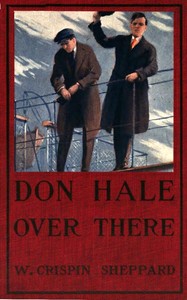
In this second series volume, Don Hale serves as a Red Cross ambulance driver on the Western Front, where battlefield danger intertwines with a mystery at the Château de Morancourt. The excerpts show a focus on trench warfare, camaraderie among drivers, and a treasure-hunt subplot, though the catalog subject 'treasure troves' is only hinted at in the introduction.
Editorial Edition Score
4.7/5
★★★★★
★★★★★
Calculated from edition completeness, EPUB availability, text structure and catalogue metadata. Not a user rating.
How this score is calculated
- Description quality20 pts
- Title & short description10 pts
- Source metadata20 pts
- Text length15 pts
- Chapters / structure15 pts
- EPUB file integrity20 pts
Total of 100 points, scaled to a 2.5-5.0 range. Editions with an empty description or a missing EPUB file are not scored.
Edition quality
Read the Text
tan had no difficulty in translating the following:
"Don't judge too soon. Give him a chance. I'll bet he'll make good."
"A grouch of the first class, Don."
Again: "Don't judge too soon."
"What's the matter--do you chaps think you're woodpeckers?" broke in Bodkins. "Come, boys, let's entertain ourselves. How's this for improvising?"
And the musician, twanging his banjo, began to sing and play in a decidedly lusty manner.
"Pardon--I thought you wanted us to entertain ourselves," snickered "Peewee" Burns, a very fat, round-faced driver. "Fellows, Bodkins' improvisations have about the same effect on me as Boche shells falling uncomfortably close. I can't beat it too fast."
"Humph!--there's another arrow from jealousy's quiver that slipped harmlessly past," grunted Bodkins. "Why, you poor, ignorant chump, you couldn't tell the difference between music and the blare of a Klaxon."
Then, quite satisfied with this crushing retort, Bodkins began once more. Loudly, and with a most extraordinary accent, he sang some of the latest songs of the poilus,[1] and the others helped him manfully in the chorus.
[Footnote 1: Literally "hairy ones." The affectionate slang term that all France applies to its private soldiers.]
Thus, for fully fifteen minutes there was so much jollification and noise in the room that the sounds from without were effectually denied an entrance.
At length John Weymouth raised his hand.
"Hold on, boys," he cried. "Enough of this kind of music is too much. What's the next number on the program?"
"Let's all take turns jumping on Bodkins' banjo," suggested "Peewee," pleasantly. "I've got a pair of extra-heavy boots."
"There's enough danger about without inviting any more," laughed Wendell. "Somebody tell a story. Now's your chance, Chase."
The latter shook his head.
"Sorry I can't oblige," he said. "But my gift of gab is less than is usually given to mortals."
"He's sure to ring in something about painting or artists," declared "Peewee." "It's a most oddly odd thing what a grip art and music get on some people."
"Commonplace individuals of course can't be expected to understand it," remarked the musician, loftily. "Your bleatings, 'Peewee,' are----"
"Order, order!" interrupted the Sous Chef. "Dunstan has the platform."
"What shall it be--fact or fiction?" asked the art student.
"Give us a little true fiction," remarked Wendell, with a laugh.
Dunstan took a quick turn or two across the room, looked up at the ceiling, then down at the bare planks beneath his feet. Finally he raised his head so as to survey the crowd.
"By George, fellows, that effect of light and shade on your faces and figures is simply corking!" he cried, with enthusiasm. "Rembrandt himself----"
"I told you!" snickered "Peewee."
"The story first and Rembrandt afterward," commented Watts.
"All right, boys." Dunstan, with a sigh of resignation, seated himself on the edge of the table and began swinging his legs to and fro. "I'll relate a little bit of truth that may sound like fiction. Hello!"
Two other concussions, though not quite so loud as the one previously heard, crashed in upon his sentence.
Chase squirmed uneasily in his seat. It required no skilled observer to detect the fact that his nerves were shaking.
"Confound it!" he muttered.
"Oh, that's nothing," Weymouth assured him. "When they hit the house next door it'll be time enough to worry."
"As I wasn't saying," resumed Dunstan, after a moment or two had passed, "my story concerns a French château--one of those typical old châteaus dating from the feudal ages, and within the massive walls of which----"
"He's getting off to a good, flowery start, all right," chirruped "Peewee."
"The nobles and landed gentry dwelt." Then, with a cheery laugh, Dunstan continued, in a more matter-of-fact way: "Just the other day a couple of poilus gave me the tale I'm now passing along to you. In this ancient château, which the Germans shelled and partly wrecked, there lived a direct descendent of one of those old-time seigneurs. The soldiers declared he resided in the great château alone, with a retinue of servants, and that he had the reputation of being an eccentric old chap with one great hobby."
"And what was that?" queried Wendell.
"The collection of paintings and objects of art."
"There it comes, boys!--the art stuff again!" exclaimed "Peewee," yawning. "Say, this is a fairy tale, eh, Dunstan?"
His words were couched in a tone of accusation.
"No, mon ami, not a bit of it," declared the art student, earnestly. "A long article concerning the Morancourt case appeared in a Paris newspaper."
"Morancourt? Why, that's the old place right near us here--up toward the front!"
"That's the very place, my son."
"Hah! The plot thickens. What is the 'case' you spoke of?"
The opening chapter of Don Hale Over There introduces the reader to a group of Red Cross ambulance drivers in a relatively quiet sector of the Western Front. The dialogue immediately establishes a contrast between the seasoned “old veteran” and the skeptical newcomer Chase, whose reluctance to engage hints at internal conflict. The setting is a dugout, where the men’s banter is punctuated by the threat of an imminent German attack. The narrative voice is brisk and colloquial, with phrases like “whizz!—bang!” and “no children’s party” setting a tone of grim realism tempered by youthful bravado.
Battlefield Realism and the Red Cross Role
The excerpts from later chapters depict a sustained attack sequence that emphasizes the physical and sensory chaos of trench warfare. The description of “veritable streams of shot and shell” crashing overhead and the “bluish haze” of gunpowder smoke conveys a palpable atmosphere of danger. The Red Cross drivers are shown actively participating in rescue efforts, such as lifting a timber to free a wounded poilu. The text notes that their prior experiences have hardened them, but the scene still evokes the horror of war: “the attack had exacted its full toll of dead and wounded.” The dialogue includes the French phrase “Ils ne passeront pas!”—a historical rallying cry from the Battle of Verdun—which grounds the fiction in real wartime rhetoric.
Character Dynamics and the Mystery Subplot
The introduction to the volume mentions that Don and his friends become involved in “a mystery which hovers over the ancient Château de Morancourt.” However, the provided excerpts do not include any scenes at the château or references to treasure. Instead, the focus remains on the ambulance drivers’ interactions and the tension between Don and the reluctant Chase. The chapter titles, such as “The Light in the Window” and “The Treasure,” suggest that the mystery unfolds later in the narrative. Based solely on the excerpts, the mystery subplot appears secondary to the war action, and the catalog subject “treasure troves” may be a minor element rather than a central plot driver.
Narrative Structure and Serial Context
As the second volume in a series, Don Hale Over There assumes prior knowledge of the first book, Don Hale in the War Zone. The introduction summarizes that earlier volume, which involved Don seeking his father, an aviator. The present volume picks up with Don already serving as an ambulance driver. The chapter titles—ranging from “Under Fire” to “The Chemin de Mort” (Road of Death)—suggest a linear progression through combat experiences, interspersed with mystery elements. The excerpts show a pattern of alternating between dialogue-heavy scenes and action sequences, with a third-person narrator who occasionally uses French terms. The serial nature means that character arcs and the resolution of the château mystery likely depend on events from the first book.
Readers approaching Don Hale Over There should be aware that the excerpts primarily showcase the war-adventure aspects, while the treasure-mystery hinted at in the catalog may occupy a smaller portion of the narrative. The book’s 1918 publication date places it firmly within the contemporary context of World War I, and its depiction of ambulance service reflects a specific niche in juvenile war fiction. Those interested in the series’ continuity may wish to start with the first volume to understand Don’s backstory and the setup for the château plot.
Sometimes a story stays with you not for its plot, but for its quiet moments—the lull between shellfire where someone hands you coffee and a secret. That’s how I felt reading about Don Hale, and oddly, it reminded me of a gentler kind of lingering in Wongo and the Wise Old Crow — Themes and Context. Both leave that warm, wondering ache, like a tune you hum without noticing.
Mila Clark
3 weeks agoElijah Green
1 month agoScarlett Robinson
1 month agoIsaac Williams
1 month agoThere are no comments for this eBook.
Reader reflection
Take a moment to reflect on this book
Create a short personal record of your experience with this book.
Your progress
0
/
10
2
What was your overall reaction to the book?
3
Is this a title you would suggest to others?
4
How demanding did the text feel?
5
Do you expect to return to this book?
6
Which part made the strongest impression?
7
Did the book give you something worth debating?
8
How original did the book feel?
9
In one sentence, what did you learn?
10
Samuel Baker
1 month ago