1

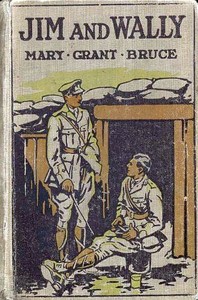
Jim and Wally — Reading Notes
(7 User reviews)
2231
Project Gutenberg
2019
Not confirmed
World War, 1914-1918 -- Juvenile fiction; Ireland -- Juvenile fiction; Families -- Juvenile fiction
Readers of public-domain and historical texts
Project Gutenberg digital edition
en
Edition facts
Words
72,816
Reading time
317 min
Text sections
8
The catalog record for Jim and Wally — Reading Notes provides practical reading context through 72,816 words, 5 hr 17 min estimated reading time, and 8 detected text sections.
The text analysis averages about 15.4 words per sentence, while the detected sections provide another way to judge how the source is divided.
Project Gutenberg metadata also associates the work with “World War, 1914-1918 -- Juvenile fiction,” connecting these edition facts with the source record’s subject description.
Source:
Project Gutenberg record #60445
In Mary Grant Bruce's 1917 novel, Australian boys Jim and Wally navigate wartime trenches and Irish landscapes, where contrasts between mechanized warfare and rural tranquility, luxury cars and humble ass-carts, shape their adventures.
Editorial Edition Score
4.7/5
★★★★★
★★★★★
Calculated from edition completeness, EPUB availability, text structure and catalogue metadata. Not a user rating.
How this score is calculated
- Description quality20 pts
- Title & short description10 pts
- Source metadata20 pts
- Text length15 pts
- Chapters / structure15 pts
- EPUB file integrity20 pts
Total of 100 points, scaled to a 2.5-5.0 range. Editions with an empty description or a missing EPUB file are not scored.
Edition quality
Read the Text
d then sandbags; and then more boards, added as the mud rose up and swallowed all that was put down upon it. Some of the last-added boards had almost disappeared, ground out of sight by the trampling feet of hundreds of men: a new battalion had relieved, three nights before, the men who had held that part of the line for a week, and when a relief arrives, a trench becomes uncomfortably filled, and the ground underfoot is churned into deep glue. It was more than time to put down another floor; to which the only objection was that no more flooring material was available, and had there been, no one had time to fetch it.
It was the second trench. Beyond it was another, occupied by British soldiers: beyond that again, a mass of tangled barbed-wire, and then the strip of No-Man’s Land dividing the two armies—a strip ploughed up by shells and scarred with craters formed by the bursting of high explosives. Here and there lay rifles, and spiked German helmets, and khaki caps; but no living thing was visible save the cheeky Flemish sparrows that hopped about the quiet space, chirping and twittering as if trying to convince themselves and everybody else that War was hundreds of miles away. The sparrows carried out this pleasant deception every morning, abandoning the attempt as soon as the first German gun began what the British soldiers, disagreeably interrupted in frying bacon, termed “the breakfast hate.” Then they retreated precipitately to the sparrow equivalent to a dug-out, to meditate in justifiable annoyance on the curious ways of men.
In the second trench the men were weary and heavy-eyed, and even bacon had scant attractions for them. It was their first experience of trench-life complicated by shell-fire, and since their arrival the enemy had been “hating” with a vigour that seemed to argue on his part a peculiar sourness of temper. Now, after two days of incessant artillery din and three nights of the strenuous toil that falls upon the trenches with darkness, the new men bore evidence of exhaustion. Casualties had been few, considering the violent nature of the bombardment; but to those who had never before seen Death come suddenly, an even slighter loss would have been horrifying. The ceaseless nerve-shattering roar of the big guns pounded in their brains long after darkness had put an end to the bombardment; their brief snatches of sleep were haunted by the white faces of the comrades with whom they would laugh and fight and work no more. They were stiff and sore with crouching under the parapets and in the narrow dug-outs; dazed with noise, sullen with the anger of men who have been forced to endure without making any effort to hit back. But their faces had hardened under the test. A few were shrinking, “jumpy,” useless: but the majority had stiffened into men. When the time for hitting back came, they would be ready.
Dawn on the fourth morning found them weary enough, but, on the whole, in better condition than they had been two days earlier. They were getting used to it; and even to artillery bombardment “custom hath made a property of easiness.” The first sense of imminent personal danger had faded with each hour that found most of them still alive. Discipline and routine, making each officer and man merely part of one great machine, steadied them into familiar ways, even in that unfamiliar setting. And above all was satisfaction that after months of slow training on barrack-square and peaceful English fields they were at last in the middle of the real thing—doing their bit. It had been conveyed to them that they were considered to be shaping none too badly: a curt testimonial, which, passing down the line, had lent energy to a hard night of rebuilding parapets, mending barbed-wire, and cleaning up battered sections of trench. They were almost too tired to eat. But the morning—so far—was peaceful; the sunlight was cheery, the clean breeze refreshing. Possibly to-day might find the Hun grown weary of hating so noisily. There were worse things than even a trench in Flanders on a bright April morning.
The novel opens in a Flanders trench where mud swallows boards and sandbags, and Flemish sparrows flee at the first German gun—what soldiers call “the breakfast hate.” This precise, ironic detail sets a tone that balances grim reality with wry observation. Bruce then shifts the action to Ireland, where the boys fish for trout and encounter a mysterious, wealthy stranger whose touring-car is fitted with electric lamps, folding arm-chairs, and a silver vase for roses. The juxtaposition of trench mud and motor-luxury is deliberate: the war never fully recedes, but the Irish countryside offers a different kind of contest—against trout, terrain, and social codes.
Trench Mud and Sparrows
The opening chapter establishes a sensory world of sodden boards, deep glue, and the “cheeky Flemish sparrows” that pretend war is far away until the guns begin. Bruce’s description of the trench is methodical: boards, sandbags, more boards, all swallowed by mud. The men are weary, bacon loses appeal, and the enemy’s “breakfast hate” is a daily ritual. This is not a heroic charge but a grinding, filthy wait. The sparrows’ retreat to a “sparrow equivalent to a dug-out” injects dark humor. The excerpt shows Bruce’s control of tone—she can render the physical misery of trench life without melodrama, and she trusts the reader to feel the weight of exhaustion. The war is a constant pressure, not a backdrop.
A Car That Sleeps Two
When Wally meets a sick man on a boreen, he is drawn into a world of mechanical luxury: a touring-car with “three little arm-chairs which folded flat,” an electric cooker, and a silver vase with roses. The owner explains he uses the car as a bedroom, with Con the chauffeur cooking camp-fashion. Wally, who prefers horses, is nonetheless impressed. The car is a mobile home, a self-contained refuge from the war and from loneliness. Bruce lingers on the “contraptions”—pockets, flaps, a clock, speedometer—as if cataloging a new kind of domesticity. This attention to material detail mirrors the earlier trench inventory, but here the objects signal comfort and control. The contrast is sharp: the trench swallows everything; the car contains everything.
Letters and Loughs
Wally’s errand is to post “the family’s letters” on Australian mail-day. The mention anchors the boys’ identity: they are Australians abroad, maintaining a link to home across oceans. The fishing at Lough Nacurra is a counterpoint to war—patient, absorbing, and frustrating. The trout are “tantalizing” and “engrossing,” a different kind of battle. Bruce uses the Irish landscape as a space where the war is distant but not forgotten. The stranger’s invitation to lunch interrupts the fishing, and Wally’s hesitation is real: he wants the trout, but the tired eyes win. The novel’s rhythm alternates between action and reflection, between the urgency of war and the slow pace of a Donegal afternoon. The letters, the lough, the car—all are threads connecting the boys to a larger world.
Readers should attend to how Bruce uses objects—trench boards, sparrows, motor fittings, fishing gear—as anchors for mood and meaning. The war is never far, but it is often indirect, felt through exhaustion or absence rather than battle scenes. The Irish sections reward attention to landscape and local detail, especially the boreens and loughs that shape the boys’ movements. The novel’s structure, shifting from Flanders to Donegal, invites comparison between two kinds of struggle: one lethal, one patient.
That rainy afternoon, Jim and Wally’s trench mud felt strangely close, yet their Irish lane with the ass-cart seemed centuries away. I closed the book, thinking about quiet resilience in noisy times. The thought lingered, and I stumbled onto Wongo and the Wise Old Crow — Themes and Context, where a different kind of stillness meets cunning. It felt like finding the same warm hearth in another room.
Mila Walker
3 weeks agoThere are no comments for this eBook.
Reader reflection
Your personal reading reflection
Build a private reading journal entry for this title.
Your progress
0
/
10
2
How did the book work for you overall?
3
Is this a title you would suggest to others?
4
How demanding did the text feel?
5
Did you gain anything practical from the text?
6
How clear did the writing feel?
7
Did the book deliver what you hoped for?
8
Did you relate to its people, ideas, or situations?
9
What changed or sharpened your thinking?
10
David Torres
3 weeks ago