1

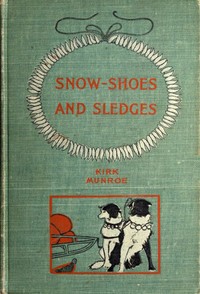
Snow-shoes and Sledges A Sequel to "The Fur-Seal's Tooth" — Context and Discussion
(6 User reviews)
1741
Project Gutenberg
2019
Not confirmed
Adventure stories; Voyages and travels -- Juvenile fiction; Frontier and pioneer life -- Juvenile fiction; Alaska -- Juvenile fiction
Readers of public-domain and historical texts
Project Gutenberg digital edition
en
Edition facts
Words
83,409
Reading time
363 min
Text sections
41
This digital edition of Snow-shoes and Sledges A Sequel to "The Fur-Seal's Tooth" — Context and Discussion is described by source-level measurements including 83,409 words, 6 hr 3 min estimated reading time, and 41 detected text sections.
The text analysis averages about 21.8 words per sentence, while the detected sections provide another way to judge how the source is divided.
Project Gutenberg metadata also associates the work with “Adventure stories,” connecting these edition facts with the source record’s subject description.
Source:
Project Gutenberg record #59240
This editorial note examines the economic and logistical tensions in Kirk Munroe's Alaskan adventure, focusing on supply costs, dog-team travel, and the Yukon gold rush setting as revealed in the provided excerpts.
Editorial Edition Score
4.9/5
★★★★★
★★★★★
Calculated from edition completeness, EPUB availability, text structure and catalogue metadata. Not a user rating.
How this score is calculated
- Description quality20 pts
- Title & short description10 pts
- Source metadata20 pts
- Text length15 pts
- Chapters / structure15 pts
- EPUB file integrity20 pts
Total of 100 points, scaled to a 2.5-5.0 range. Editions with an empty description or a missing EPUB file are not scored.
Edition quality
Read the Text
o clearly, and was so sturdily supported by Serge, that they were finally won over to his way of thinking. So the discontented engineer was forced to yield to the wishes of the majority.
Five miles from Pastolik they stopped at the Eskimo village of Coatlik for a supply of wood, and here Serge, with his ability to speak Russian, proved invaluable. Not only did he conduct the wood negotiations, but he succeeded in purchasing a number of freshly killed wild-geese, which were at that time flying southward in vast flocks. Above all, he secured a native pilot, who promised to go with them until they met running ice.
Nor did the services of the young Russo-American diminish one whit in value after Coatlik was left behind. He alone knew how to prepare the broths which formed the sole nourishment that the sick man was able to take. He only could converse with the native pilot, and learn from him the mysteries of the mighty river. He it was who was always cheerful, and could swing the lustiest axe, when, as often happened, they were obliged to renew their supply of fuel from chance drift piles; and it was he who must attend the sick man at night, because the faintest murmur served to wake him. So Serge was the very life of that dreary voyage, and but for him Phil knew it must have been abandoned long before they reached the haven for which they were steering.
And it was a dreary voyage. Day after day witnessed the same monotony of turbid waters, so widespread that one bank was often invisible from the other, and a deadly level of drowned lands bounded only by the low, far-away horizon. Day after day brought the same gray skies, chill winds, rain squalls, and flurries of snow. Every night saw heavy frosts, and it grew hourly more apparent that the stern reign of winter was close at hand.
At long intervals lonely groups of sod-covered huts gave sign that human beings dwelt even in those unlovely wastes, but save for fuel the young commander of the _Chimo_ would not pause to make their acquaintance. From earliest dawn until dusk he forced the little craft at full speed against the swift current, often grounding on sand-bars in spite of the native pilot, whose only knowledge was of the best channel but not of its obstructions.
After two days they began to see low hills on the north, and on this side the river-bank became noticeably higher. Although this was encouraging, it produced but slight impression on the spirits of the depressed crew, whose situation was indeed becoming alarming. They were worn out with anxiety, overwork, and insufficient food, for they had neither the time nor inclination to do any cooking except for the sick. The captain lay in a state of semi-stupor, and another cot within the same enclosure held one of the millwrights, who had been stricken with the dread disease twenty-four hours later.
By the end of the first week in October they were some two hundred miles from the mouth of the river, with nearly one hundred yet to go before they could reach Anvik, to gain which Phil was directing all his energies. He knew not what they would find there; but he had an intuition that help of some kind awaited them at that point. At any rate, he was determined to reach it somehow.
On the 7th of October ice began to run in the river, and with its first appearance the native pilot insisted upon starting back towards his now distant home. That night, amid the howlings of a tempest that threatened to tear the _Chimo_ from her anchorage, the stricken millwright died.
When Phil went to the engineer’s room to report this distressing news he was filled with wrath to find that individual lying in his bunk and indulging to excess in the contents of a case of brandied peaches that he had stolen from the cargo.
Without a word Phil picked up the case and flung it into the river. “I’ll see you again in the morning, sir, when you are sober,” he said, as he left the room, and, locking the door, put the key in his own pocket.
That night of storm, death, and despair was one that neither Phil nor Serge will ever forget. For long hours they sat by the bedside of the captain, whom they believed to be sleeping, discussing in low tones their melancholy situation.
Suddenly they were startled by a voice from the sick man, who said, feebly, “Get me to Anvik, boys, if you can, and you will save my life.”
In the Yukon gold fields of the 1890s, a barrel of flour cost thirty dollars and a pair of rubber boots eighteen. These figures, drawn from Phil Ryder's observations in the trading post at Forty Mile, anchor Kirk Munroe's Snow-shoes and Sledges in a world where distance and difficulty inflate every necessity. The novel, a sequel to The Fur-Seal's Tooth, follows its young protagonist as he navigates not only the physical hazards of Arctic travel—ice-choked rivers, wolf packs, and blizzards—but also the economic realities of a remote mining camp. The text balances adventure with a steady attention to prices, supplies, and the logistics of moving goods and people across a frozen landscape.
The Price of Provisions
Munroe devotes unusual space to the cost of living in the diggings. When Phil Ryder arrives at Forty Mile, he finds flour at $30 per barrel, bacon at 35 cents per pound, and canned fruit at 60 cents per pound. Coarse flannel shirts sell for $8, and rubber boots for $18. Even sledge dogs, purchased at Anvik for $5 or $6, are valued at $25 apiece. These details are not mere background color; they drive the plot. The news of a steamer bringing a sawmill, mining machinery, and goods at half the prevailing prices creates “a very pleasant excitement” among the miners. Phil’s first major action is to rent the largest building in camp—formerly a saloon—and paint a sign reading “Yukon Trading Company, Gerald Hamer, Agent.” The economic stakes are as high as the physical ones.
Routes and Rations
The excerpt describes two supply routes to the Yukon diggings: an overland trail from Dyea that requires portaging goods around rapids and canyons, and a sea route to St. Michaels followed by river steamer. Munroe emphasizes the labor involved—trees must be felled, lumber sawed, boats built for the final five hundred miles. The journey takes months, and the cost of freight shapes every decision. Phil’s party travels by sledge, and the text notes the value of dogs as both transport and commodity. The contrast between the overland route’s backbreaking portages and the river steamers’ bulk capacity underscores the region’s isolation. Even the mention of “enchanted” prices—the miners’ term for inflated costs—adds a wry note to the hardship.
Character Through Commerce
Munroe uses economic transactions to reveal character. When Jalap Coombs, the sailor-man, is recognized by an old shipmate named Skiff Bettens, the reunion hinges on shared history rather than commerce. But the setting is a mining camp where a new sign promises “increased business facilities,” and the cheers from miners suggest that commerce is community. Phil’s decision to rent a former saloon and turn it into a trading post shows his adaptability. The text also notes that Serge and two Indians go upriver for firewood, “a precious article in Forty Mile.” These small details—the price of wood, the value of a dog, the cost of a shirt—build a world where survival depends on both grit and good accounting.
Readers approaching Snow-shoes and Sledges will find a story that moves as much by ledger as by sled. The excerpts suggest that Munroe’s adventure is grounded in the material realities of the gold rush: the cost of a barrel of flour matters as much as the danger of a wolf attack. Pay attention to the prices, the routes, and the goods—they are not decoration but the framework of the narrative.
That rainy afternoon I kept thinking about how much a Yukon dog team costs in flour and beans, the sheer arithmetic of survival. Munroe made me feel the cold weight of provisions. It reminded me of another winter, harsher still, told with the same quiet respect for endurance. I pulled down Kak, the Copper Eskimo — Inside the Classic afterwards, and the snow there felt even deeper.
There are no comments for this eBook.
Reader reflection
How did this book work for you?
Your answers remain private and are stored only in this browser.
Your progress
0
/
10
2
Was reading this book enjoyable?
3
Is this a title you would suggest to others?
4
How much effort did this book require?
5
Did this book create an emotional response?
6
Could you follow the author’s main argument?
7
Which part made the strongest impression?
8
How personally connected did you feel to the book?
9
What is the main idea you are taking away?
10


Avery Hill
1 month ago