1

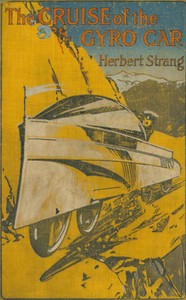
The Cruise of the Gyro-Car — A Closer Reading
(11 User reviews)
3374
Project Gutenberg
2022
Not confirmed
Voyages and travels -- Juvenile fiction; Europe -- Juvenile fiction; Inventions -- Juvenile fiction; Motor vehicles, Amphibious -- Juvenile fiction
Readers of public-domain and historical texts
Project Gutenberg digital edition
en
Edition facts
Words
56,822
Reading time
248 min
Text sections
22
The source record for The Cruise of the Gyro-Car — A Closer Reading measures this digital text at 56,822 words, 4 hr 8 min estimated reading time, and 22 detected text sections.
The text analysis averages about 16.6 words per sentence, while the detected sections provide another way to judge how the source is divided.
Project Gutenberg metadata also associates the work with “Voyages and travels -- Juvenile fiction,” connecting these edition facts with the source record’s subject description.
Source:
Project Gutenberg record #67642
An editorial note examining how Herbert Strang's 1911 adventure novel uses the gyro-car's amphibious mobility to structure a journey through early 20th-century Europe, with particular attention to the interplay between mechanical travel and traditional landscapes.
Editorial Edition Score
4.9/5
★★★★★
★★★★★
Calculated from edition completeness, EPUB availability, text structure and catalogue metadata. Not a user rating.
How this score is calculated
- Description quality20 pts
- Title & short description10 pts
- Source metadata20 pts
- Text length15 pts
- Chapters / structure15 pts
- EPUB file integrity20 pts
Total of 100 points, scaled to a 2.5-5.0 range. Editions with an empty description or a missing EPUB file are not scored.
Edition quality
Read the Text
te. He did not so much as lift his eyes as the vehicle passed, and George turned his head aside: the brothers might have been strangers.
For several days George was hardly to be seen. He had ordered a new front wheel and fork from the maker, and until they arrived forbore to speak of the gyro-car, and occupied himself in repairing the wind-screen in front, and in working at various mechanical models with which he was experimenting. He was going up to Cambridge in October, and the science master at his school foretold that he would take a first-class in the engineering tripos, if he would only concentrate himself and not dabble in things outside the curriculum.
The new parts arrived. On the next day Maurice was strolling past the workshop, which he had never yet deigned to enter, when his attention was arrested by the sight of his brother’s car standing by itself on the path. A faint humming proceeded from its interior. George was not to be seen. In spite of himself, Maurice found himself gazing at the machine with interest, for, though it had four wheels tandem, and was not supported on either side, it stood perfectly upright. He glanced round furtively to make sure that his brother was not watching, and then walked round the car, stooping at every few paces to look beneath it and assure himself that he was not mistaken. There were no supports; the machine was actually balancing itself on its four wheels.
“Rummy!” he murmured. “How’s it done?”
He was peeping over the side of the car, when George’s voice hailed him heartily.
“Hallo, Maurice! Isn’t she a beauty?”
Instantly he moved away, and began to stroll down the path as if nothing could be less worthy of his attention.
“Swank!” said George to himself.
He turned the starting-handle, mounted into the car, depressed the clutch-pedal, and having advanced the speed-lever a little, ran up the path, out at the front gate, and disappeared.
Maurice flung his cigarette away, looking a trifle disconcerted. He went to his room opening on to the road, and remained at the window until he heard the hum of the car returning. Then he slipped into the garden, and was sauntering up and down, when George ran the machine down the path to its garage.
“I’ve had a jolly spin,” said George. “Nearly ran into a foreign fellow in the village: there appears to be a little colony of foreigners there: come to try boating, I suppose.”
He sprang out of the car, causing it to set up a slight rocking motion, and went into his workshop. Maurice stood at a distance of a few yards, contemplating what was to him an embodied mystery.
The machine was several feet longer than an ordinary motor-car, but about half as wide, and shaped like a boat. Indeed, its general appearance was that of a motor-cycle which had broken through the bottom of a rowing boat. Abaft amidships there was a seat for two persons, arranged pannier fashion, and sunk somewhat below the top of the framework on which it rested. A little to the rear of the seat was a glass chamber, in which were two top-like things, connected by a bar. It was, apparently, from these that the humming proceeded, but they were not visibly rotating, though they swayed slightly. In front was the casing, presumably covering the motor; behind was a similar object, but smaller.
George came out of the workshop.
“Hallo!” he said, as if recognising his brother for the first time. “Taking a squint?”
“What are those things?” asked Maurice, nodding towards the glass case.
“Those? Oh, they’re the gyroscopes.”
He got into the car, and let down, one on each side, two supports, each with a small wheel at the end. Then he moved a lever to stop the spinning of the gyroscopes, got out again, lifted the cover of the motor, and proceeded to oil the engine. For some time not a word was spoken. Then Maurice broke the silence.
“Er! H’m! What, may I ask, is a gyroscope?”
“H’m! Do you think you could manage to speak in words of more than one syllable?”
“Well, gyroscope has three.”
“Undoubtedly. I am still a little doubtful as to the accuracy of your definition, or perhaps I should say, of the perfectness of my apprehension. Will you condescend to be lucid?”
“Oh, you want to be treated to a lecture in mechanics, do you? Are you sure it won’t hurt you? Aren’t you afraid of your name getting into the papers?”
Maurice opened his cigarette-case and offered it to his brother.
“Thanks, old man,” said George, contritely. “Got a light?”
The gyro-car is not merely a vehicle in Herbert Strang's 1911 novel; it is the narrative's organizing principle. The story's movement between scenes is governed by the car's capabilities—it travels on land, water, and air—allowing the plot to shift rapidly from a bullet-ridden mountain pass to a remote Albanian village. This mechanical versatility creates a structure where each new setting is introduced by the car's arrival, and the journey itself becomes the primary thread connecting disparate episodes.
The Gyro-Car as a Structural Device
The gyro-car's amphibious and aerial functions dictate the rhythm of the story. The narrative advances in bursts of travel followed by pauses for encounters, as when the car ascends a cliff path under gunfire, then stops to pick up a fugitive. Each leg of the journey is defined by the car's mode—driving, flying, or floating—and the terrain it must negotiate. This mechanical pacing gives the novel a episodic structure, where the vehicle's capabilities determine both the possibilities and limitations of each scene.
Recurring Images of Verticality and Enclosure
The excerpts repeatedly contrast open vistas with confined spaces. The car moves through a “narrow defile” and climbs a “still narrower path” before reaching a village clustered at the foot of a hill. Inside the Albanian house, the travellers enter a “vast dark room” with smoke-blackened rafters, weapons, and dried meat hanging from the walls. The narrative eye shifts between the expansive view of a “snow-capped mountain” and the cramped interior of a kula, where a millstone blocks a window. This oscillation between height and enclosure reinforces the sense of a journey that is both physical and cultural.
Movement Between Mechanical and Traditional Worlds
The gyro-car intrudes into a landscape defined by ancient customs. The Albanian village reacts with a child screaming and fleeing at the sight of the machine. Yet the car also enables the travellers to participate in local life: they are welcomed into a blood-feud household, where the presence of guests suspends hostilities. The narrative moves between the car's modern, mobile perspective and the static, ritualized world of the village. This juxtaposition is not merely scenic; it structures the plot, as the car's arrival triggers a chain of social obligations and dangers.
The Role of the Landscape as an Active Force
The landscape in the excerpts is not a passive backdrop but an active participant. Bullets strike the cliff face, “bespattering” the car with clay; the path bends sharply, hiding the travellers from view; the oak forest lies “far below,” glimpsed through a cleft. The terrain shapes the action: the narrow path forces the car to slow down, the cliff provides cover, and the river appears as a “silver thread” from above. The narrative's movement is constantly negotiated with the physical environment, which resists or aids the gyro-car's progress. This gives the journey a tactile, immediate quality.
Readers attentive to the novel's structure will notice how the gyro-car's mechanical nature creates a pattern of arrival, observation, and departure. The story does not linger; each scene is framed by the car's entry and exit. This makes the book less a series of adventures than a travelogue with a machine as its protagonist. The landscape and the vehicle are in constant dialogue, and the narrative's energy comes from their friction.
Reading about the gyro-car’s steady hum over old cobblestones, I kept thinking of a quieter kind of motion—the unhurried drift through memory in The Oxbow Wizard — Story, Setting & Ideas. Both feel like journeys where the machine or the mind moves, yet the landscape stays patient, waiting to be noticed.
There are no comments for this eBook.
Reader reflection
Before you leave, reflect on the book
Use these questions to collect your thoughts before moving on.
Your progress
0
/
10
2
Did this book hold your interest?
3
Would you encourage someone else to read it?
4
Did the language feel accessible?
5
Did the book give you something worth debating?
6
How original did the book feel?
7
Would you read this book again?
8
How would you describe its reading pace?
9
In one sentence, what did you learn?
10

Sofia Brown
1 month ago