About 123 minutes
Dido, the Dancing Bear: His Many Adventures — Inside the Classic
Childrens Adventures
28,233 recorded words. 3 minutes difference from this book's estimate.
View Gutenberg source #61450
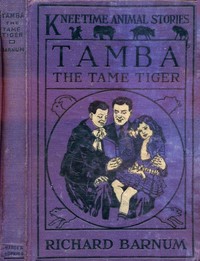
The catalog record for Tamba, the Tame Tiger: His Many Adventures — Key Ideas to Explore provides practical reading context through 28,769 words, 2 hr 6 min estimated reading time, and 13 detected text sections.
The text analysis averages about 15.4 words per sentence, while the detected sections provide another way to judge how the source is divided.
Project Gutenberg metadata also associates the work with “Animals -- Juvenile fiction,” connecting these edition facts with the source record’s subject description.
Explore this collection
These alternatives are selected using recorded categories and estimated reading time.
About 123 minutes
Childrens Adventures
28,233 recorded words. 3 minutes difference from this book's estimate.
View Gutenberg source #61450About 121 minutes
Childrens Adventures
27,808 recorded words. 5 minutes difference from this book's estimate.
View Gutenberg source #57559About 134 minutes
Childrens Adventures
30,661 recorded words. 8 minutes difference from this book's estimate.
View Gutenberg source #58626Search stored excerpts and compare books → Choose by your preferences →
Choices use stored catalog measurements. Estimates vary with reading speed. A shared category is a catalog label, not a claim that two books have the same argument or literary quality.
Search reads excerpt text stored with this catalog and links to its associated Gutenberg record. The connection is stored in the site database; this tool does not recheck that every excerpt is word-for-word identical to that external record. Excerpt search does not cover every chapter and does not verify historical publication dates.
Catalog snapshot checked: 2026-09-26. Coverage: 90 public books, 90 available source excerpts.
Calculated from edition completeness, EPUB availability, text structure and catalogue metadata. Not a user rating.
Total of 100 points, scaled to a 2.5-5.0 range. Editions with an empty description or a missing EPUB file are not scored.
Public-domain source text
The source text is kept in the dedicated reader, separate from this catalogue record and its commentary.
Richard Barnum opens Tamba, the Tame Tiger with a growl: “Here! Don’t you do that again, or I’ll scratch you!” The line immediately establishes Tamba’s irritable mood and the animal-language conceit that governs the book. Barnum signals that these creatures speak “just as your dog and cat talk to one another, by mewing and barking,” a framing device that invites young readers to imagine a hidden, vocal animal society. The opening chapter introduces a cast of circus animals—Nero the lion, Tum Tum the elephant, Chunky the hippo, Dido the bear—each with a distinct voice and temperament. Tamba’s crossness is not merely stated; it is performed through short, imperative sentences and the repeated “Burr-r-r-r!” that mimics a tiger’s growl. This editorial note examines how Barnum uses diction, dialogue tags, and descriptive details to build a consistent, child-friendly animal world.
Barnum assigns each animal a characteristic verb of speech: Tamba growls, Nero roars but often speaks “in a very gentle voice indeed,” Tum Tum rumbles, and Squinty the pig squeals and grunts. These tags do more than label who is speaking; they reinforce the animal’s physical nature. When Tamba says “Burr-r-r-r!” the onomatopoeia bridges human language and tiger sound. Dialogue is often punctuated with exclamation points, conveying urgency or emotion. The pigs’ conversation about sour milk uses the colloquial “You’re eating all my sour milk!” and the repeated “I want something to eat just as much as you do!”—a natural, childlike squabble. Barnum avoids complex syntax; sentences are short and declarative, mirroring how a child might imagine animals talking.
Barnum describes settings with minimal but functional detail. The circus cages are “close together in the circus tent”; the pig pen is “a low building without any roof.” Actions are rendered in straightforward sequences: “Tamba ran for what he thought was the doorway of a cave.” The author relies on concrete nouns and active verbs—crept, popped, splashed—to keep the narrative moving. When Squinty tips a pail of whitewash, the description is vivid but brief: “The whitewash splashed out and splattered on the tame tiger.” Barnum does not linger on sensory details; he gives just enough for a child to picture the scene. This economy extends to the animals’ physical descriptions: Squinty has “a queer droop to one eye” that “seemed to be looking in two ways at once,” a single trait that defines his comical appearance.
A pattern emerges across the excerpts: an animal in need approaches another group, is initially rebuffed, and then a confrontation or trick ensues. Tamba, hungry and homeless, asks the pigs for food; Squinty refuses, and Tamba threatens to bite him. The conflict is resolved not by violence but by Squinty’s clever use of whitewash. This structure—request, refusal, threat, comic resolution—recurs in the series formula. Barnum also uses cross-references to other books in the Kneetime Animal Stories series: Squinty is identified as “the comical pig” from his own volume, and Tinkle the pony appears later. These references create a shared universe without requiring prior knowledge. The animals’ names often signal their defining trait: Squinty squints, Tamba is tame (though not always), Tum Tum is jolly.
Despite the title, Tamba is not consistently tame. The opening chapter shows him cross and threatening; later, he is hungry and pleading. Barnum uses the word “tame” as a label rather than a fixed personality trait. When Tamba says “I remember once, in the jungle, eating a little pig who looked something like you,” the line recalls his wild origins and undercuts his domestication. The author balances this by having Tamba speak politely when asking for milk (“It smells like milk to me”) and by showing him outwitted by a pig. The tiger’s voice shifts from growly to plaintive, reflecting his changing circumstances. Barnum never lets Tamba become truly dangerous; the threat is always deflated by humor or a sudden turn. This careful modulation keeps the tiger sympathetic while acknowledging his predatory nature.
Barnum’s authorial choices in Tamba, the Tame Tiger prioritize clarity and repetition over literary complexity. The dialogue-driven narrative, the patterned conflicts, and the economical descriptions all serve a young audience just learning to follow a story. Readers familiar with the Kneetime Animal series will recognize the formula; newcomers will find a self-contained adventure. Pay attention to how Barnum uses animal sounds and speech tags to create distinct personalities without lengthy exposition. The tiger’s tameness is tested but never broken, a narrative constraint that shapes every encounter.
There’s a gentleness in how Barnum lets Tamba’s voice stay soft even among the circus noise, a quiet dignity that lingers after you close the book. It reminded me of the calm patience I felt reading Boy Scouts in the North Sea; Or, the Mystery of "U-13" — Key Ideas to Explore—that same unhurried attention to small details, as if the story itself breathes slowly. Some books just keep their warmth with you.
Use these questions to collect your thoughts before moving on.