About 243 minutes
Pemrose Lorry, Radio Amateur — Reading Notes
Childrens Adventures
55,809 recorded words. 1 minutes difference from this book's estimate.
View Gutenberg source #62371
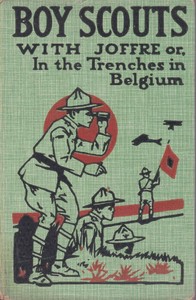
This digital edition of Boy Scouts with Joffre; Or, In the Trenches in Belgium — Reading Companion is described by source-level measurements including 56,042 words, 4 hr 4 min estimated reading time, and 6 detected text sections.
The text analysis averages about 11.8 words per sentence, while the detected sections provide another way to judge how the source is divided.
Project Gutenberg metadata also associates the work with “War stories,” connecting these edition facts with the source record’s subject description.
Explore this collection
These alternatives are selected using recorded categories and estimated reading time.
About 243 minutes
Childrens Adventures
55,809 recorded words. 1 minutes difference from this book's estimate.
View Gutenberg source #62371About 245 minutes
Childrens Adventures
56,257 recorded words. 1 minutes difference from this book's estimate.
View Gutenberg source #64315About 242 minutes
Childrens Adventures
55,467 recorded words. 2 minutes difference from this book's estimate.
View Gutenberg source #67185Search stored excerpts and compare books → Choose by your preferences →
Choices use stored catalog measurements. Estimates vary with reading speed. A shared category is a catalog label, not a claim that two books have the same argument or literary quality.
Search reads excerpt text stored with this catalog and links to its associated Gutenberg record. The connection is stored in the site database; this tool does not recheck that every excerpt is word-for-word identical to that external record. Excerpt search does not cover every chapter and does not verify historical publication dates.
Catalog snapshot checked: 2026-09-26. Coverage: 90 public books, 90 available source excerpts.
Calculated from edition completeness, EPUB availability, text structure and catalogue metadata. Not a user rating.
Total of 100 points, scaled to a 2.5-5.0 range. Editions with an empty description or a missing EPUB file are not scored.
Public-domain source text
The source text is kept in the dedicated reader, separate from this catalogue record and its commentary.
The opening scene of three motorcyclists in Boy Scout uniforms speeding across Long Island establishes a distinctly American frame for a story whose title promises trenches in Belgium. The narrator describes the riders as “like fleeting ghosts” with muffled engines, a detail that emphasizes stealth over spectacle. The dialogue, peppered with period slang such as “Nix on the cop!” and “beat it right out of town,” suggests a colloquial, informal voice aimed at a young readership. The catalog subjects list “War stories” and “World War, 1914-1918 – Juvenile fiction,” yet the excerpts show no combat; instead, the boys pursue a spy called “The Rat” through Paris, using motorboats and aeroplanes. The war functions more as a backdrop for a chase narrative than as a subject of realistic depiction.
The dialogue in the excerpts is dense with early twentieth-century American slang. Jimmie, the red-headed Wolf Patrol member, is the most frequent source: “Nix on the drink!” and “my dream book said” are typical of his speech. The boys address each other by first names—Jack, Harry, Ned—and use nicknames like “The Rat” for the antagonist. The narrator occasionally adopts a formal, almost cinematic tone (“Without a moment’s delay both boys shut off power and applied brakes”), but the characters’ exchanges remain breezy and colloquial. This contrast between the narrator’s efficient action descriptions and the boys’ slangy banter creates a hybrid voice that is part adventure serial, part schoolyard repartee. The slang also anchors the story firmly in its era; phrases like “beat it” and “you never can tell” would have felt contemporary to a 1910s reader.
The excerpts revolve around the pursuit of a spy called “The Rat,” who is described only through his actions and the boys’ reactions. He is said to have “blocked that door to the cellar” and to have impersonated a servant to steal papers from an aeroplane. The boys debate his motives: Jimmie insists he is “beating it for Berlin,” while Jack and Harry fear he will “remain and make another effort to work them harm.” The enemy is never seen directly in the provided text; he is always reported or inferred. This absence keeps the focus on the boys’ deductive reasoning and camaraderie rather than on direct confrontation. The spy’s elusiveness aligns with the adventure genre’s reliance on mystery and pursuit, but it also means the war itself remains abstract—a setting for a cat-and-mouse game rather than a conflict with clear stakes.
The boys’ mobility is central to the plot. They begin on motorcycles, then shift to a police boat, and later to an aeroplane called the Gray Eagle. The aeroplane is described as “looming up before them in the street,” and a guard notes that “an aeroplane is no longer wonderful,” suggesting that the story capitalizes on the novelty of flight while acknowledging its growing familiarity. The Gray Eagle is both a vehicle and a prize: the spy attempts to steal papers from it. The boys’ ability to move quickly across landscapes—from Long Island to Paris—mirrors the serialized structure of the book, with each chapter likely introducing a new location or mode of transport. The technology is presented as exciting but matter-of-fact; the boys handle motorcycles and aeroplanes with competence, reinforcing the self-reliant, resourceful image of the Boy Scouts.
The excerpts from Boy Scouts with Joffre reveal a work that uses the First World War as a setting for a chase story centered on Boy Scout ingenuity and teamwork. The catalog subjects accurately reflect the presence of war and scouting, but the actual text prioritizes dialogue, slang, and technological mobility over historical or tactical detail. Readers expecting a realistic portrayal of trench warfare will instead find a fast-paced adventure with a faceless enemy and a focus on the boys’ interactions. The book is best approached as a period piece of juvenile fiction, where the war serves as an exciting backdrop rather than a subject of exploration.
It’s funny how the boys in the trenches lean on each other, a kind of steadying that feels more like home than any map. I was reminded of that quiet solidarity reading through this old companion, the way loyalty quietly shapes adventure. Something similar lingers in The Camp Fire Girls; Or, The Secret of an Old Mill — Story, Setting & Ideas, though its secrets are gentler, woven with summer light.
Your answers remain private and are stored only in this browser.