About 240 minutes
Boy Scouts in California; or, The Flag on the Cliff — Story, Setting & Ideas
Childrens Adventures
54,986 recorded words. 1 minutes difference from this book's estimate.
View Gutenberg source #65418
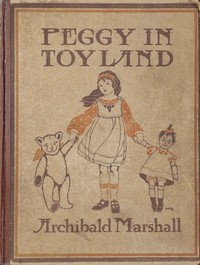
The catalog record for Peggy in Toyland — Story, Setting & Ideas provides practical reading context through 55,274 words, 4 hr 1 min estimated reading time, and 23 detected text sections.
The text analysis averages about 17.9 words per sentence, while the detected sections provide another way to judge how the source is divided.
Project Gutenberg metadata also associates the work with “Toys -- Juvenile fiction,” connecting these edition facts with the source record’s subject description.
Explore this collection
These alternatives are selected using recorded categories and estimated reading time.
About 240 minutes
Childrens Adventures
54,986 recorded words. 1 minutes difference from this book's estimate.
View Gutenberg source #65418About 242 minutes
Childrens Adventures
55,467 recorded words. 1 minutes difference from this book's estimate.
View Gutenberg source #67185About 243 minutes
Childrens Adventures
55,809 recorded words. 2 minutes difference from this book's estimate.
View Gutenberg source #62371Search stored excerpts and compare books → Choose by your preferences →
Choices use stored catalog measurements. Estimates vary with reading speed. A shared category is a catalog label, not a claim that two books have the same argument or literary quality.
Search reads excerpt text stored with this catalog and links to its associated Gutenberg record. The connection is stored in the site database; this tool does not recheck that every excerpt is word-for-word identical to that external record. Excerpt search does not cover every chapter and does not verify historical publication dates.
Catalog snapshot checked: 2026-09-26. Coverage: 90 public books, 90 available source excerpts.
Calculated from edition completeness, EPUB availability, text structure and catalogue metadata. Not a user rating.
Total of 100 points, scaled to a 2.5-5.0 range. Editions with an empty description or a missing EPUB file are not scored.
Public-domain source text
The source text is kept in the dedicated reader, separate from this catalogue record and its commentary.
Archibald Marshall opens Peggy in Toyland with a description of Peggy that is notably precise: she has 'very long rather straight hair, blue eyes, a dear little pudgy nose, and a small mouth.' The phrase 'dear little pudgy nose' is a telling authorial choice—it blends a child's perspective with a narrator's affectionate judgment, setting a tone that is both intimate and slightly formal. This duality recurs throughout the excerpts, particularly in the dialogue between Peggy and Queen Rosebud, where the Queen's stately diction ('I shall know what to do') contrasts with Peggy's colloquial earnestness ('most awfully glad').
The narrator's voice in the opening chapter is notable for its measured, almost parental tone. When describing the two wooden figure-heads, the narrator observes that 'there was something agreeable in the appearance of both of them,' a phrase that avoids childish enthusiasm in favor of a gentle, observational quality. This voice also permits speculative asides—'Peggy used to think she would have liked to know them when they were leading a more active life'—which invite the reader into Peggy's imaginative world without abandoning a grown-up narrative distance. The result is a style that feels both instructive and companionable, suitable for a child listener but never condescending.
The exchange between Peggy and Queen Rosebud reveals character through contrasting speech patterns. The Queen speaks in formal, measured sentences: 'I have always been as nice as I could to everybody.' Her indignation is expressed with dignity—'How can he have said such a thing?'—and her dismissal of Peggy is handled with courtly grace: 'I wish you had come at a happier time.' Peggy, by contrast, uses emphatic, childlike language: 'That isn't true,' 'She is as wicked as he is,' 'most awfully glad.' Marshall uses these differences not only to distinguish the two characters but also to underscore the power dynamic: Peggy's directness is effective, but the Queen's stately reserve ultimately controls the scene.
Marshall's descriptions of place are economical yet evocative. The bungalow 'built right on the beach' with 'a little lawn beside it' is sketched in few words, but the two wooden figure-heads receive more attention: one with 'her nose broken off,' the other having 'lost every bit of paint off her face.' These details are not merely decorative; they hint at histories of wear and travel, and they ground the fantasy in a tangible, slightly weathered reality. The description of the distant Island—'a little town and a little church, and a few houses scattered about among the hills'—is similarly spare, leaving room for the reader's imagination to fill in the gaps.
A recurring concern in the excerpts is the theme of trust versus deception. The Queen laments that 'they told me that the people hate me,' and Peggy counters that 'that wicked Selim has told everybody that you are dead.' The Queen's response—'My people have always been good, and I will not have them taught to tell untruths'—frames honesty as a political virtue. Peggy's internal reflection that 'if Selim were to go on ruling it might all be altered, and dolls might become as bad as some human beings' extends this theme to the nature of the toy world itself. Marshall uses the dolls' inherent goodness as a foil for the intrigue, suggesting that the fantasy realm operates on moral rules that are clearer than those of the human world.
Readers attentive to Marshall's craft will notice how he balances the whimsy of a toy kingdom with a narrator who never fully abandons adult sensibilities. The dialogue, in particular, rewards close attention: the Queen's formal cadences and Peggy's blunt sincerity create a dynamic that drives both plot and theme. The excerpts suggest a story that uses its fantasy setting to explore ideas of loyalty, justice, and the reliability of appearances—all conveyed through the specific, carefully chosen words of its characters and narrator.
The rain kept me indoors that Tuesday, and I drifted through Peggy in Toyland, its careful notes on Queen Rosebud’s turns of phrase lingering like tea warmth. That restraint, how much a single unhurried sentence can imply—it led me, then, to Tom Pagdin, Pirate — Background and Themes, and I sat a while longer, following the quieter shadows of another story.
Use these questions to collect your thoughts before moving on.