About 241 minutes
Peggy in Toyland — Story, Setting & Ideas
Childrens Adventures
55,274 recorded words. 1 minutes difference from this book's estimate.
View Gutenberg source #68749
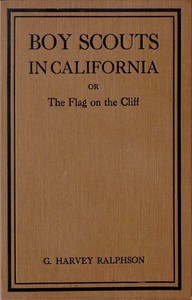
The catalog record for Boy Scouts in California; or, The Flag on the Cliff — Story, Setting & Ideas provides practical reading context through 54,986 words, 4 hr estimated reading time, and 8 detected text sections.
The text analysis averages about 14.0 words per sentence, while the detected sections provide another way to judge how the source is divided.
Project Gutenberg metadata also associates the work with “Boys -- Juvenile fiction,” connecting these edition facts with the source record’s subject description.
Explore this collection
These alternatives are selected using recorded categories and estimated reading time.
About 241 minutes
Childrens Adventures
55,274 recorded words. 1 minutes difference from this book's estimate.
View Gutenberg source #68749About 242 minutes
Childrens Adventures
55,467 recorded words. 2 minutes difference from this book's estimate.
View Gutenberg source #67185About 237 minutes
Childrens Adventures
54,430 recorded words. 3 minutes difference from this book's estimate.
View Gutenberg source #58718Search stored excerpts and compare books → Choose by your preferences →
Choices use stored catalog measurements. Estimates vary with reading speed. A shared category is a catalog label, not a claim that two books have the same argument or literary quality.
Search reads excerpt text stored with this catalog and links to its associated Gutenberg record. The connection is stored in the site database; this tool does not recheck that every excerpt is word-for-word identical to that external record. Excerpt search does not cover every chapter and does not verify historical publication dates.
Catalog snapshot checked: 2026-09-26. Coverage: 90 public books, 90 available source excerpts.
Calculated from edition completeness, EPUB availability, text structure and catalogue metadata. Not a user rating.
Total of 100 points, scaled to a 2.5-5.0 range. Editions with an empty description or a missing EPUB file are not scored.
Public-domain source text
The source text is kept in the dedicated reader, separate from this catalogue record and its commentary.
The novel opens with Jimmie McGraw and Frank Shaw broiling bear steak below the timber line of the Sierra Nevada, joking about cannibalism and patrol identity. The precise geography—Mono Lake, Twin Peaks, Rancheria Creek—anchors the scene in a real landscape, while the dialogue establishes character voices: Jimmie's quick wit and Frank's steady leadership. This early banter, combined with a voice from a cave asking about room service, signals a blend of humor and outdoor competence that defines the tone.
The opening chapter's playful tone—complete with bear-steak puns and a cave-hotel gag—gives way to a stark shift in the middle excerpt. Here, the boys face the Devil's Punch Bowl, a geological feature described as having “almost perpendicular” walls and a pool at the bottom. The dialogue loses its levity: Frank admits, “We’ve got to take the chance,” and Jack confesses fear. The rescue attempt is narrated with technical detail about ledges, slopes, and the risk of falling. This contrast between the early campfire camaraderie and the later life-or-death engineering suggests the novel uses humor to build rapport before testing the characters under pressure.
Ralphson does not treat California as a mere backdrop. The opening paragraph names specific peaks (Matterhorn, Twin Peaks, Warren Peak) and water bodies (Mono Lake, Tuolumne River, Rancheria Creek), grounding the story in a recognizable Sierra Nevada setting. In the Devil's Punch Bowl scene, the terrain dictates the action: the boys must navigate “eighty per cent slope” and crumbling ledges, and the pool’s cold temperature becomes a tactical problem. The landscape is not just scenic but functional—it creates obstacles that require Scout skills to overcome. Readers familiar with California geography may recognize these locations, while others will experience them as vividly described hazards.
The excerpts reveal character through conversation. In the opening, Jimmie’s joke about “cannibal stunt” and the cave voice’s quip about room service establish a playful dynamic. Later, the rescue dialogue shows a different register: Frank and Jack speak in short, urgent sentences, using terms like “chum” and “old boy” to maintain morale. Frank’s line, “all you got to do is to face a dreaded thing and half its terror is lost,” encapsulates a Scout-like philosophy of courage. The boys do not lecture each other; they model problem-solving through talk, weighing risks and encouraging one another. This naturalistic dialogue, free of overt moralizing, lets the reader infer the values of loyalty and bravery from action.
The table of contents offers a roadmap of escalating stakes. Early chapters like “A Thief in the Night” and “A Voice in the Thicket” suggest mystery, while later titles such as “The Devil’s Punch Bowl,” “A Fight in the Air,” and “The Treaty Under the Flag” promise action and resolution. The middle excerpt, from Chapter XI, delivers on that promise with a tense rescue. The chapter titles also hint at recurring motifs: “The Law of Club and Fang” and “The Call of the Pack” evoke wilderness themes, while “A Bribe of Half a Million” introduces a plot element not present in the excerpts. This structure guides a first reader to expect a mix of survival challenges and adventure plotting, with the flag on the cliff as a likely symbolic goal.
First-time readers should pay attention to how Ralphson balances humor and hazard. The early banter is not filler; it establishes the characters’ voices and their bond, which makes the later danger more affecting. The specific geography is worth noting, as it is not generic but integral to the plot. Finally, the dialogue carries the story’s themes without heavy exposition—listen to what the boys say to each other, and you will see the Scout ethos in action.
Reading about the Scouts’ cliff rescue, I remembered scrambling up a slick riverbank as a kid, heart hammering, that same mix of fear and focus. Jim and Wally — Reading Notes brought back that feeling too, but quieter—more about the stillness after trouble passes, when the sun finally reaches your shoulders and you just sit, breathing. Both books capture that odd, plain calm.
Create a short personal record of your experience with this book.