About 318 minutes
The quest of the Silver Swan: A land and sea tale for boys — A Closer Reading
Childrens Adventures
73,034 recorded words. 1 minutes difference from this book's estimate.
View Gutenberg source #68182
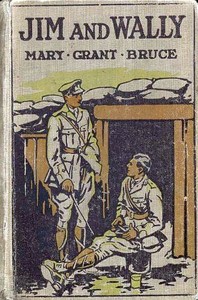
The catalog record for Jim and Wally — Reading Notes provides practical reading context through 72,816 words, 5 hr 17 min estimated reading time, and 8 detected text sections.
The text analysis averages about 15.4 words per sentence, while the detected sections provide another way to judge how the source is divided.
Project Gutenberg metadata also associates the work with “World War, 1914-1918 -- Juvenile fiction,” connecting these edition facts with the source record’s subject description.
Explore this collection
These alternatives are selected using recorded categories and estimated reading time.
About 318 minutes
Childrens Adventures
73,034 recorded words. 1 minutes difference from this book's estimate.
View Gutenberg source #68182About 320 minutes
Childrens Adventures
73,551 recorded words. 3 minutes difference from this book's estimate.
View Gutenberg source #60446About 307 minutes
Childrens Adventures
70,474 recorded words. 10 minutes difference from this book's estimate.
View Gutenberg source #65869Search stored excerpts and compare books → Choose by your preferences →
Choices use stored catalog measurements. Estimates vary with reading speed. A shared category is a catalog label, not a claim that two books have the same argument or literary quality.
Search reads excerpt text stored with this catalog and links to its associated Gutenberg record. The connection is stored in the site database; this tool does not recheck that every excerpt is word-for-word identical to that external record. Excerpt search does not cover every chapter and does not verify historical publication dates.
Catalog snapshot checked: 2026-09-26. Coverage: 90 public books, 90 available source excerpts.
Calculated from edition completeness, EPUB availability, text structure and catalogue metadata. Not a user rating.
Total of 100 points, scaled to a 2.5-5.0 range. Editions with an empty description or a missing EPUB file are not scored.
Public-domain source text
The source text is kept in the dedicated reader, separate from this catalogue record and its commentary.
The novel opens in a Flanders trench where mud swallows boards and sandbags, and Flemish sparrows flee at the first German gun—what soldiers call “the breakfast hate.” This precise, ironic detail sets a tone that balances grim reality with wry observation. Bruce then shifts the action to Ireland, where the boys fish for trout and encounter a mysterious, wealthy stranger whose touring-car is fitted with electric lamps, folding arm-chairs, and a silver vase for roses. The juxtaposition of trench mud and motor-luxury is deliberate: the war never fully recedes, but the Irish countryside offers a different kind of contest—against trout, terrain, and social codes.
The opening chapter establishes a sensory world of sodden boards, deep glue, and the “cheeky Flemish sparrows” that pretend war is far away until the guns begin. Bruce’s description of the trench is methodical: boards, sandbags, more boards, all swallowed by mud. The men are weary, bacon loses appeal, and the enemy’s “breakfast hate” is a daily ritual. This is not a heroic charge but a grinding, filthy wait. The sparrows’ retreat to a “sparrow equivalent to a dug-out” injects dark humor. The excerpt shows Bruce’s control of tone—she can render the physical misery of trench life without melodrama, and she trusts the reader to feel the weight of exhaustion. The war is a constant pressure, not a backdrop.
When Wally meets a sick man on a boreen, he is drawn into a world of mechanical luxury: a touring-car with “three little arm-chairs which folded flat,” an electric cooker, and a silver vase with roses. The owner explains he uses the car as a bedroom, with Con the chauffeur cooking camp-fashion. Wally, who prefers horses, is nonetheless impressed. The car is a mobile home, a self-contained refuge from the war and from loneliness. Bruce lingers on the “contraptions”—pockets, flaps, a clock, speedometer—as if cataloging a new kind of domesticity. This attention to material detail mirrors the earlier trench inventory, but here the objects signal comfort and control. The contrast is sharp: the trench swallows everything; the car contains everything.
Wally’s errand is to post “the family’s letters” on Australian mail-day. The mention anchors the boys’ identity: they are Australians abroad, maintaining a link to home across oceans. The fishing at Lough Nacurra is a counterpoint to war—patient, absorbing, and frustrating. The trout are “tantalizing” and “engrossing,” a different kind of battle. Bruce uses the Irish landscape as a space where the war is distant but not forgotten. The stranger’s invitation to lunch interrupts the fishing, and Wally’s hesitation is real: he wants the trout, but the tired eyes win. The novel’s rhythm alternates between action and reflection, between the urgency of war and the slow pace of a Donegal afternoon. The letters, the lough, the car—all are threads connecting the boys to a larger world.
Readers should attend to how Bruce uses objects—trench boards, sparrows, motor fittings, fishing gear—as anchors for mood and meaning. The war is never far, but it is often indirect, felt through exhaustion or absence rather than battle scenes. The Irish sections reward attention to landscape and local detail, especially the boreens and loughs that shape the boys’ movements. The novel’s structure, shifting from Flanders to Donegal, invites comparison between two kinds of struggle: one lethal, one patient.
That rainy afternoon, Jim and Wally’s trench mud felt strangely close, yet their Irish lane with the ass-cart seemed centuries away. I closed the book, thinking about quiet resilience in noisy times. The thought lingered, and I stumbled onto Wongo and the Wise Old Crow — Themes and Context, where a different kind of stillness meets cunning. It felt like finding the same warm hearth in another room.
Build a private reading journal entry for this title.