About 111 minutes
Pep: The Story of a Brave Dog — Story, Setting & Ideas
Childrens Adventures
25,315 recorded words. 2 minutes difference from this book's estimate.
View Gutenberg source #59909
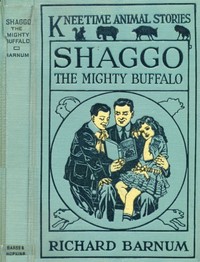
Shaggo, the Mighty Buffalo: His Many Adventures — Themes and Context can be approached with a clearer sense of reading commitment from its source measurements: 25,926 words, 1 hr 53 min estimated reading time, and 13 detected text sections.
The text analysis averages about 14.4 words per sentence, while the detected sections provide another way to judge how the source is divided.
Project Gutenberg metadata also associates the work with “Animals -- Juvenile fiction,” connecting these edition facts with the source record’s subject description.
Explore this collection
These alternatives are selected using recorded categories and estimated reading time.
About 111 minutes
Childrens Adventures
25,315 recorded words. 2 minutes difference from this book's estimate.
View Gutenberg source #59909About 110 minutes
Childrens Adventures
25,160 recorded words. 3 minutes difference from this book's estimate.
View Gutenberg source #61888About 109 minutes
Childrens Adventures
24,896 recorded words. 4 minutes difference from this book's estimate.
View Gutenberg source #65360Search stored excerpts and compare books → Choose by your preferences →
Choices use stored catalog measurements. Estimates vary with reading speed. A shared category is a catalog label, not a claim that two books have the same argument or literary quality.
Search reads excerpt text stored with this catalog and links to its associated Gutenberg record. The connection is stored in the site database; this tool does not recheck that every excerpt is word-for-word identical to that external record. Excerpt search does not cover every chapter and does not verify historical publication dates.
Catalog snapshot checked: 2026-09-26. Coverage: 90 public books, 90 available source excerpts.
Calculated from edition completeness, EPUB availability, text structure and catalogue metadata. Not a user rating.
Total of 100 points, scaled to a 2.5-5.0 range. Editions with an empty description or a missing EPUB file are not scored.
Public-domain source text
The source text is kept in the dedicated reader, separate from this catalogue record and its commentary.
From the opening scene on the dry, dusty prairie, where Shaggo rises from chewing his cud to answer a challenge from two smaller buffalo calves, Richard Barnum establishes a pattern of movement that governs the entire narrative. The buffalo's size—he is repeatedly called "mighty" and described as the largest in the Government herd—becomes a physical fact that shapes every episode. The story moves Shaggo through a series of enclosures: the National Park, a trap, a train car, a circus wagon, and finally a winter barn. Each transition is marked by a change in the animal's body, most notably the swelling on his shoulder that first appears after his "big jump" and persists as a visible reminder of his journey.
Shaggo's injured shoulder is introduced in Chapter II as a result of his "big jump" and reappears at key moments. In the circus barn, a man notices the swelling and says, "Maybe he got hurt in the train wreck. I heard he was in one." The injury is not merely a plot device; it functions as a physical record of Shaggo's passage from wild to captive life. The text draws attention to the shoulder when Shaggo tries to run, when he is examined by circus workers, and when he is moved into a larger cage. This recurring detail anchors the reader's attention to the buffalo's body as the site where adventure leaves its mark.
The story's settings are sharply contrasted. The prairie is described as "dry, dusty" with "little showers of dirt" kicked up by running calves. In the circus, the wagon is "painted red, yellow, and green"—colors Shaggo barely registers, knowing only "the green of the grass, the whiteness of salt and the blueness of the water." The narrative moves Shaggo through a train wreck, a city street, and a winter barn, each location described with concrete sensory details: the darkness of the car, the flood of sunlight when the door opens, the rumbling ride. These shifts in setting are not merely backdrop; they structure the episodic chapters, each titled with a new location or encounter.
Barnum uses "animal talk" for the buffalo characters, rendering their dialogue in English while the humans speak only among themselves. In the opening, Shaggo speaks "in a deep, rumbly voice" to other buffalo. Later, when men approach his cage, the narrative reports their conversation directly: "'So that's the buffalo, is it?' asked one." Shaggo does not understand their words; the text notes, "Shaggo did not understand this talk." This asymmetry creates a consistent point of view: the reader follows Shaggo's perceptions and misunderstandings, while human speech remains opaque. The device reinforces the buffalo's perspective without anthropomorphizing him fully.
Shaggo's experience of the circus is defined by a series of containers: the freight car, the cage on a wagon, the "regular cage" with hay and water, and finally the winter barn. Each enclosure is described with attention to its material qualities—ropes, boards, canvas, planks. The men slide the cage "as barrels are rolled into a cellar." The circus itself is not a place of performance but of housing and transport; the story takes place in "winter quarters" where animals are kept warm. This focus on containment rather than spectacle gives the narrative a practical, almost documentary quality, tracking the logistics of moving a large animal from one confined space to another.
Readers attentive to physical detail will find that Shaggo's body—his size, his shaggy coat, his injured shoulder—carries the story's emotional weight. The episodic structure, with each chapter introducing a new setting or encounter, rewards those who notice how the buffalo's movements trace a path from open prairie to enclosed barn. The book's interest lies less in dramatic conflict than in the steady accumulation of small observations about how a mighty animal adapts to a world of cages and wagons.
There is a gentle honesty in watching Shaggo’s shoulders swell and soften under the circus lights—the journey never leaves the bones. I often think of that quiet transformation when I recall the other one, the bear who danced. Dido, the Dancing Bear: His Many Adventures — Inside the Classic carries that same patient, reluctant taming, a memory of wildness held just beneath the fur.
A brief reflection can help important ideas stay with you longer.