About 247 minutes
Don Hale Over There — Reading Notes
Childrens Adventures
56,602 recorded words. 1 minutes difference from this book's estimate.
View Gutenberg source #69037
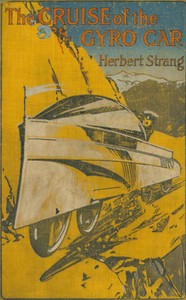
The source record for The Cruise of the Gyro-Car — A Closer Reading measures this digital text at 56,822 words, 4 hr 8 min estimated reading time, and 22 detected text sections.
The text analysis averages about 16.6 words per sentence, while the detected sections provide another way to judge how the source is divided.
Project Gutenberg metadata also associates the work with “Voyages and travels -- Juvenile fiction,” connecting these edition facts with the source record’s subject description.
Explore this collection
These alternatives are selected using recorded categories and estimated reading time.
About 247 minutes
Childrens Adventures
56,602 recorded words. 1 minutes difference from this book's estimate.
View Gutenberg source #69037About 246 minutes
Childrens Adventures
56,454 recorded words. 2 minutes difference from this book's estimate.
View Gutenberg source #67630About 245 minutes
Childrens Adventures
56,257 recorded words. 3 minutes difference from this book's estimate.
View Gutenberg source #64315Search stored excerpts and compare books → Choose by your preferences →
Choices use stored catalog measurements. Estimates vary with reading speed. A shared category is a catalog label, not a claim that two books have the same argument or literary quality.
Search reads excerpt text stored with this catalog and links to its associated Gutenberg record. The connection is stored in the site database; this tool does not recheck that every excerpt is word-for-word identical to that external record. Excerpt search does not cover every chapter and does not verify historical publication dates.
Catalog snapshot checked: 2026-09-26. Coverage: 90 public books, 90 available source excerpts.
Calculated from edition completeness, EPUB availability, text structure and catalogue metadata. Not a user rating.
Total of 100 points, scaled to a 2.5-5.0 range. Editions with an empty description or a missing EPUB file are not scored.
Public-domain source text
The source text is kept in the dedicated reader, separate from this catalogue record and its commentary.
The gyro-car is not merely a vehicle in Herbert Strang's 1911 novel; it is the narrative's organizing principle. The story's movement between scenes is governed by the car's capabilities—it travels on land, water, and air—allowing the plot to shift rapidly from a bullet-ridden mountain pass to a remote Albanian village. This mechanical versatility creates a structure where each new setting is introduced by the car's arrival, and the journey itself becomes the primary thread connecting disparate episodes.
The gyro-car's amphibious and aerial functions dictate the rhythm of the story. The narrative advances in bursts of travel followed by pauses for encounters, as when the car ascends a cliff path under gunfire, then stops to pick up a fugitive. Each leg of the journey is defined by the car's mode—driving, flying, or floating—and the terrain it must negotiate. This mechanical pacing gives the novel a episodic structure, where the vehicle's capabilities determine both the possibilities and limitations of each scene.
The excerpts repeatedly contrast open vistas with confined spaces. The car moves through a “narrow defile” and climbs a “still narrower path” before reaching a village clustered at the foot of a hill. Inside the Albanian house, the travellers enter a “vast dark room” with smoke-blackened rafters, weapons, and dried meat hanging from the walls. The narrative eye shifts between the expansive view of a “snow-capped mountain” and the cramped interior of a kula, where a millstone blocks a window. This oscillation between height and enclosure reinforces the sense of a journey that is both physical and cultural.
The gyro-car intrudes into a landscape defined by ancient customs. The Albanian village reacts with a child screaming and fleeing at the sight of the machine. Yet the car also enables the travellers to participate in local life: they are welcomed into a blood-feud household, where the presence of guests suspends hostilities. The narrative moves between the car's modern, mobile perspective and the static, ritualized world of the village. This juxtaposition is not merely scenic; it structures the plot, as the car's arrival triggers a chain of social obligations and dangers.
The landscape in the excerpts is not a passive backdrop but an active participant. Bullets strike the cliff face, “bespattering” the car with clay; the path bends sharply, hiding the travellers from view; the oak forest lies “far below,” glimpsed through a cleft. The terrain shapes the action: the narrow path forces the car to slow down, the cliff provides cover, and the river appears as a “silver thread” from above. The narrative's movement is constantly negotiated with the physical environment, which resists or aids the gyro-car's progress. This gives the journey a tactile, immediate quality.
Readers attentive to the novel's structure will notice how the gyro-car's mechanical nature creates a pattern of arrival, observation, and departure. The story does not linger; each scene is framed by the car's entry and exit. This makes the book less a series of adventures than a travelogue with a machine as its protagonist. The landscape and the vehicle are in constant dialogue, and the narrative's energy comes from their friction.
Reading about the gyro-car’s steady hum over old cobblestones, I kept thinking of a quieter kind of motion—the unhurried drift through memory in The Oxbow Wizard — Story, Setting & Ideas. Both feel like journeys where the machine or the mind moves, yet the landscape stays patient, waiting to be noticed.
Use these questions to collect your thoughts before moving on.